Learns a bounded torque surrogate for trajectory propagation from real pose trajectories, without ground-truth joint-torque measurements or a fixed current-to-joint-torque approximation.
NeuralActuator: Neural Actuation Modeling for Robot Dynamics and External Force Perception
A differentiable neural actuator model for low-cost robots that supports torque-surrogate prediction, sensorless force perception, and force-aware real-robot control.
Robotics: Science and Systems (RSS) 2026.
Outstanding Systems Paper Award at RSS 2026.
1 MIT 2 Amazon Robotics
* Research Assistant at MIT CDFG, equal contribution.
† The work of this author does not relate to their position at Amazon.
Abstract
Differentiable simulators have advanced policy learning and model-based control across diverse robotic tasks. To date, actuator dynamics remain underexplored and can be a major source of sim-to-real error, especially on low-cost platforms where the linear current-to-joint-torque approximation τ = KtI becomes unreliable under commanded-target tracking because of friction, hysteresis, backlash, and thermal effects. Beyond forward dynamics, accurate actuator models also support force perception and integrated force/position control in manipulation tasks. We present NeuralActuator, a neural actuator model that jointly predicts (i) a torque surrogate for trajectory propagation on low-cost servo platforms, (ii) external forces together with a contact-probability gate for sensorless force perception, and (iii) a motor-condition score for the supervised joint, distinguishing normal from mechanically restricted operation. We introduce a twin-arm teleoperation system that collects robot states and actuator telemetry alongside external-force labels, yielding the Neural Actuation Dataset (NAD). The torque-surrogate head is trained through differentiable simulation from pose trajectories without ground-truth joint-torque measurements. A Transformer-based architecture captures temporal dependencies while enabling efficient real-time inference. We validate NeuralActuator across three platforms: a 5-DoF OpenManipulator-X, a 6-DoF SO-101 from LeRobot, and a 7-DoF Franka Emika Panda, spanning three actuator families and costs from approximately $500 to more than $30,000. The low-cost platforms support physically plausible dynamics and enable force evaluation, while the offline Franka experiment provides an additional payload-force-estimation benchmark. We also demonstrate motor-condition estimation and improved behavior-cloning performance when NeuralActuator is used as a pretrained module. We release the dataset, code, and hardware configurations on this project page.
Overview
Low-cost robot actuation as a path to dynamics, force perception, and real-robot control.
NeuralActuator addresses actuator dynamics on low-cost robot arms, where affordable servos expose rich telemetry but the conventional linear current-to-joint-torque approximation becomes unreliable under commanded-target tracking. From command, state, tracking-error, and telemetry histories, the model predicts a torque surrogate for trajectory propagation together with external force, contact probability, and motor-condition scores. Under the implicit force coupling used in the paper, the torque surrogate alone drives the simulated body and may absorb interaction effects needed to reproduce the observed motion; it should therefore not be interpreted as an identifiable estimate of physical actuator torque.
Estimates external force and contact probability from commands, proprioception, and actuator telemetry without deployment-time force sensors.
Method
Problem formulation, NAD, and Transformer actuator model.
Problem Formulation
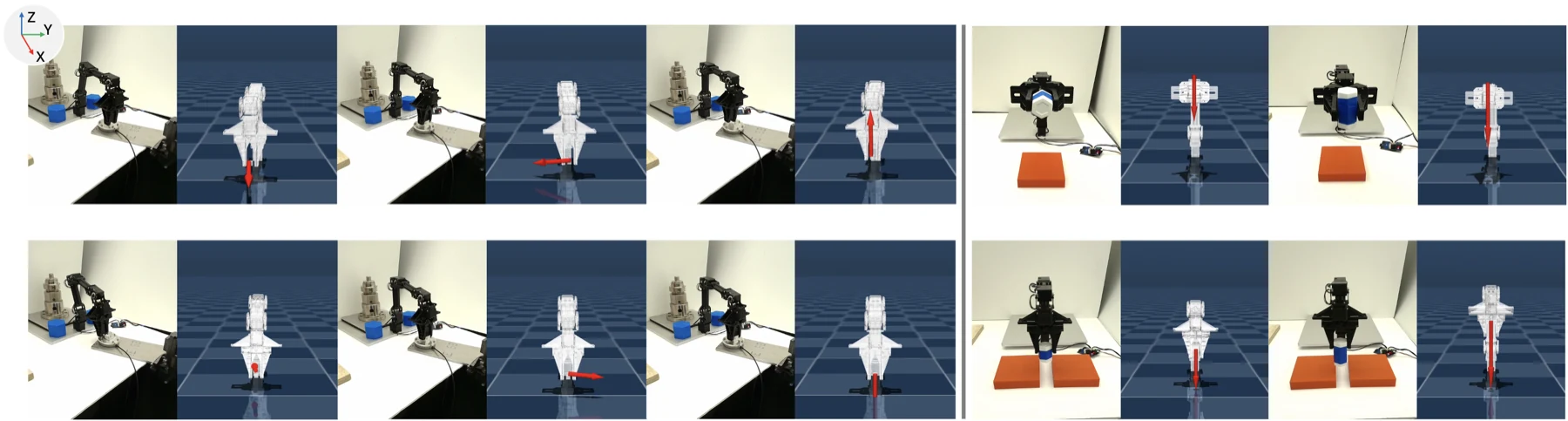
NeuralActuator maps a nine-frame history of commanded targets, proprioceptive state, tracking error, and actuator telemetry to four outputs: a pre-clipping torque surrogate, a raw 3D external-force estimate, a contact-probability gate, and per-motor condition scores. Under implicit coupling, the clipped torque surrogate alone drives the differentiable simulator; the force estimate is directly supervised but is not applied to the state update. Under explicit coupling, the predicted force is additionally applied at the force-reference point and contributes Jv(q)Tfext alongside the torque surrogate, so the rollout loss also backpropagates through the applied force. The paper uses implicit coupling, which is more accurate on both low-cost platforms; explicit coupling is more sensitive to calibration mismatch in the force-reference frame, kinematics, and inertial parameters. In the OpenManipulator-X condition benchmark, only the Joint 3 score is supervised and evaluated, distinguishing normal from mechanically restricted operation.
Neural Actuation Dataset (NAD)
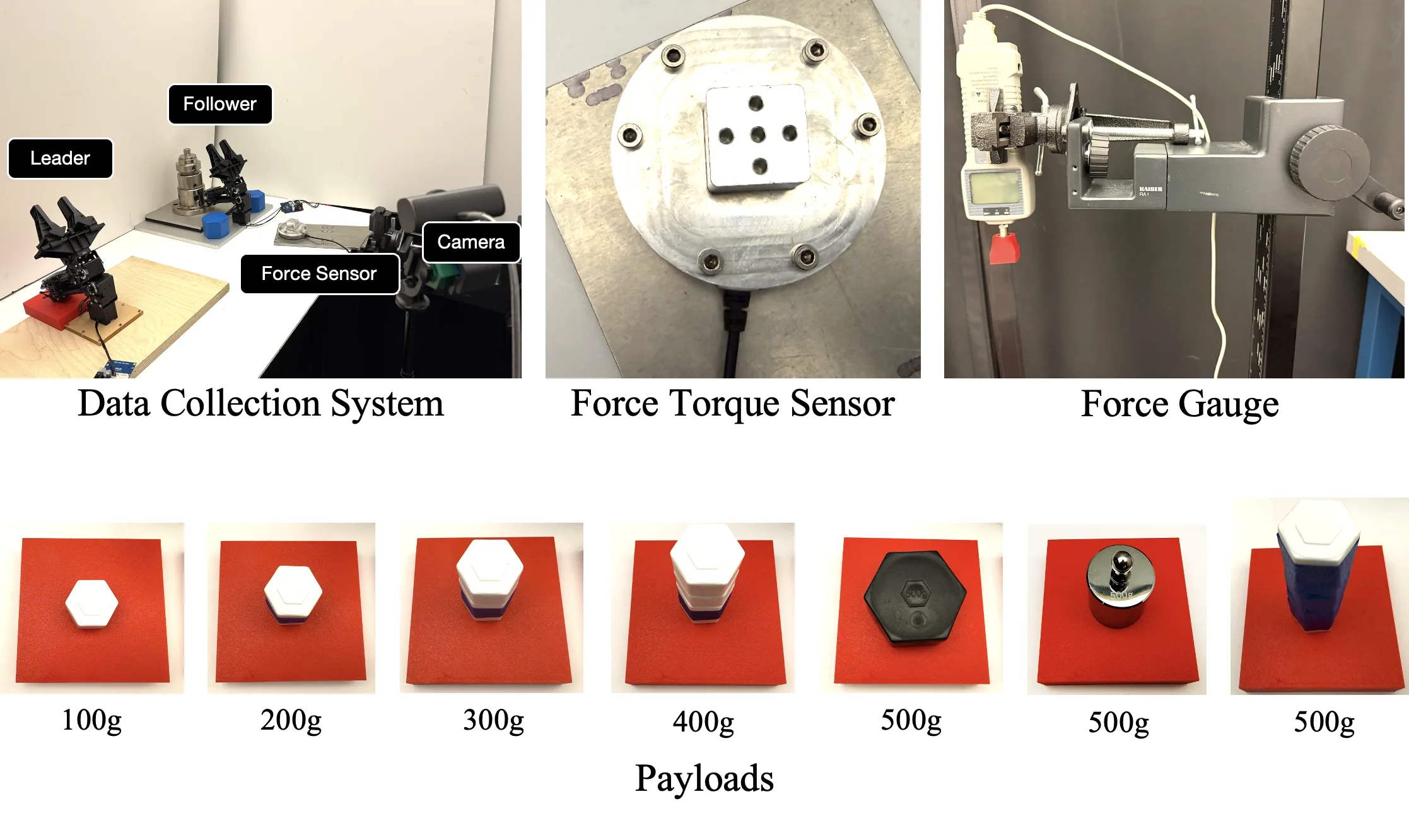
NAD is collected with a twin-arm teleoperation setup that records commanded and measured states, current, voltage, temperature, and external-force labels from known payloads or a fixture-mounted six-axis force/torque sensor. The force gauge is reserved for an independent evaluation benchmark and is not a source of NAD training supervision.
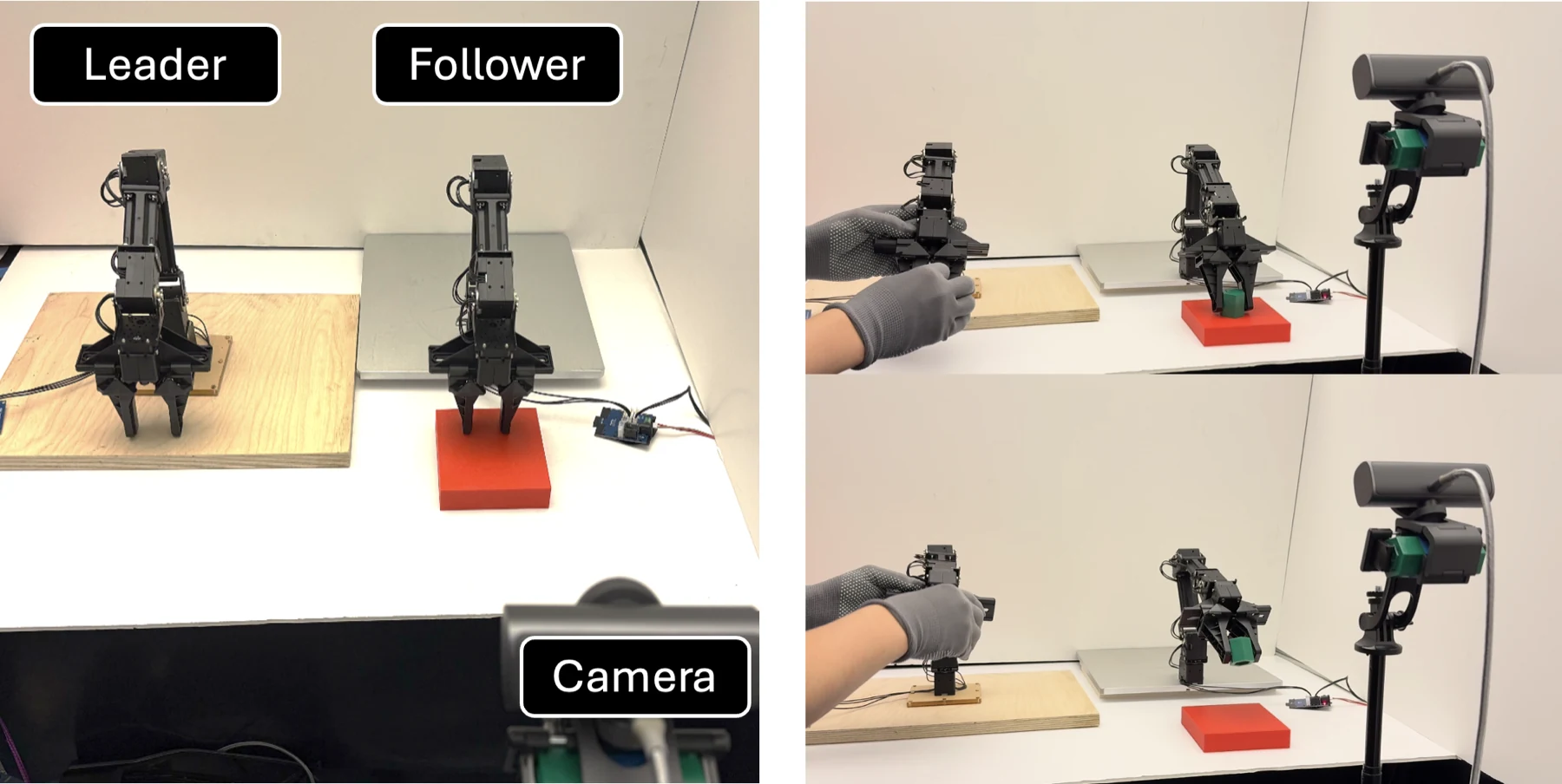
OpenManipulator-X model-development and evaluation subset. The 94.52 minutes are task-assignment durations used in the experiments; nominal trajectories reused for the condition comparison also appear in the free-motion and force-labeled categories.
| Component | Description | Duration |
|---|---|---|
| Free motion | No external force | ~34.15 min |
| Force labeled | Known weights or force sensing | ~46.24 min |
| Motor condition | Mechanically restricted Joint 3 | ~14.13 min |
| Total | - | ~94.52 min |
NeuralActuator
NeuralActuator formulates actuation as a history-dependent mapping from commanded targets, proprioception, and actuator telemetry to a torque surrogate, external force, contact probability, and motor-condition scores. The torque-surrogate head is trained through differentiable simulation from pose trajectories without ground-truth joint-torque measurements, while the force, gate, and condition heads use direct supervision when labels are available.
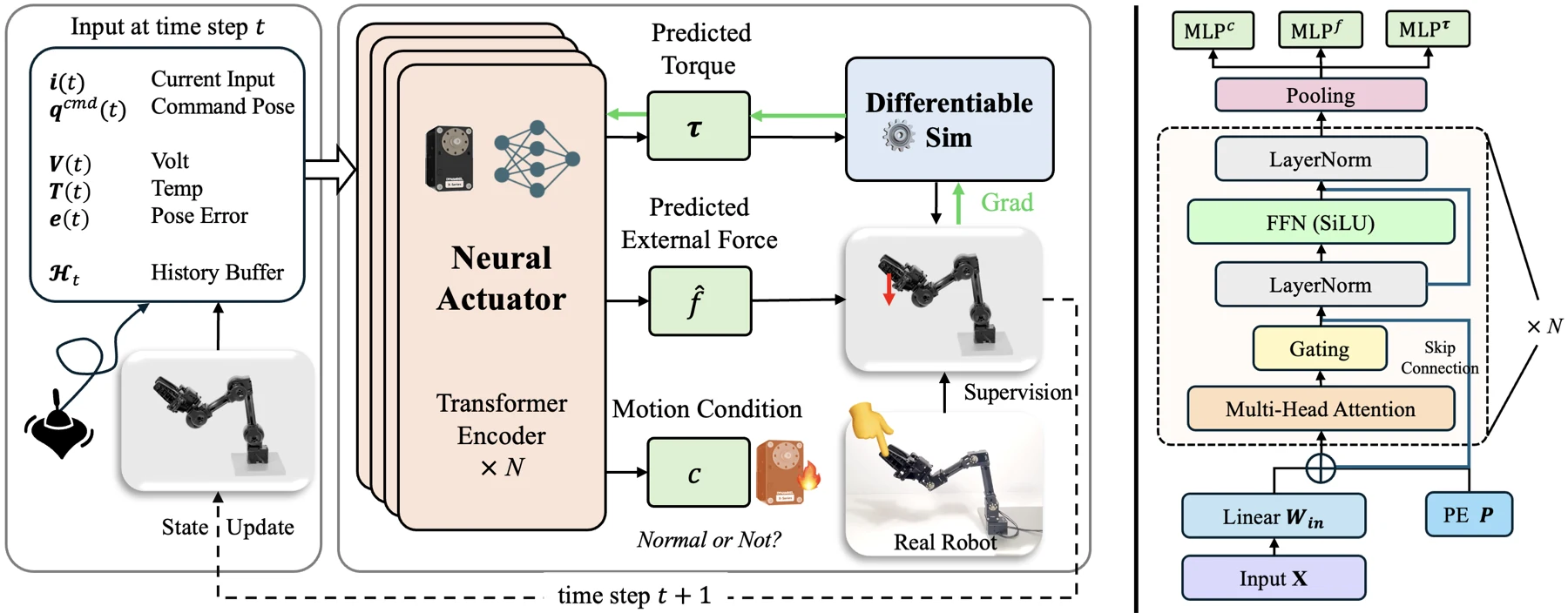
Learns a torque surrogate from real pose trajectories by backpropagating through differentiable simulation, without ground-truth joint-torque measurements or a reliable current-to-joint-torque calibration.
Uses a Transformer over commands, proprioception, and actuator telemetry to predict the torque surrogate required for trajectory propagation, capturing nonlinear and history-dependent behavior without interpreting the surrogate as calibrated physical actuator torque.
Separate heads predict the torque surrogate (τpred), 3D end-effector force (fext), contact probability (g), and per-motor condition scores (c). The manipulator equation below provides physical context; under the implicit coupling used in the paper, it is not imposed as an identifiable decomposition of actuator and external torques.
Experiments
Rollout accuracy, force estimation, baselines, motor condition, and runtime.
Rollout and Force Estimation
Accuracy summary. Joint errors are in degrees, Grip is single-finger slide-coordinate MAE in millimeters, and force errors are in Newtons.
| Benchmark | Horizon (steps) | J1 (deg) | J2 (deg) | J3 (deg) | J4 (deg) | Grip (mm) | Force (N) |
|---|---|---|---|---|---|---|---|
| No-load rollout | 600 steps | 3.1 | 2.8 | 3.2 | 3.1 | 0.2 | - |
| Force-sensor test | 500 steps | 1.78 | 3.31 | 2.01 | 1.58 | 0.65 | 0.23 |
| Weight-based test | 600 steps | 2.97 | 4.06 | 3.51 | 3.77 | 0.50 | 0.11 |
Force-estimation baselines. All entries are force MAE in Newtons (N). Lower is better; bold marks the best value in each column. NeuralActuator predicts external force from simulated rollout states, while classical baselines consume ground-truth states at each step.
| Method | Go Up 200g (N) | Go Up 300g (N) | Go Up 400g (N) | Pick 200g (N) | Pick 300g (N) | Pick 400g (N) | Pick 500g (N) | Avg. (N) |
|---|---|---|---|---|---|---|---|---|
| ID-Linear | 1.37 | 1.81 | 2.30 | 0.72 | 0.95 | 1.22 | 1.47 | 1.41 |
| ID-Friction | 1.06 | 1.59 | 2.15 | 0.62 | 0.82 | 1.10 | 1.31 | 1.23 |
| GMO | 0.58 | 0.66 | 1.23 | 0.33 | 0.47 | 0.63 | 0.75 | 0.66 |
| NeuralActuator | 0.12 | 0.20 | 0.07 | 0.24 | 0.00 | 0.19 | 0.05 | 0.12 |
Joint 3 Condition and Runtime
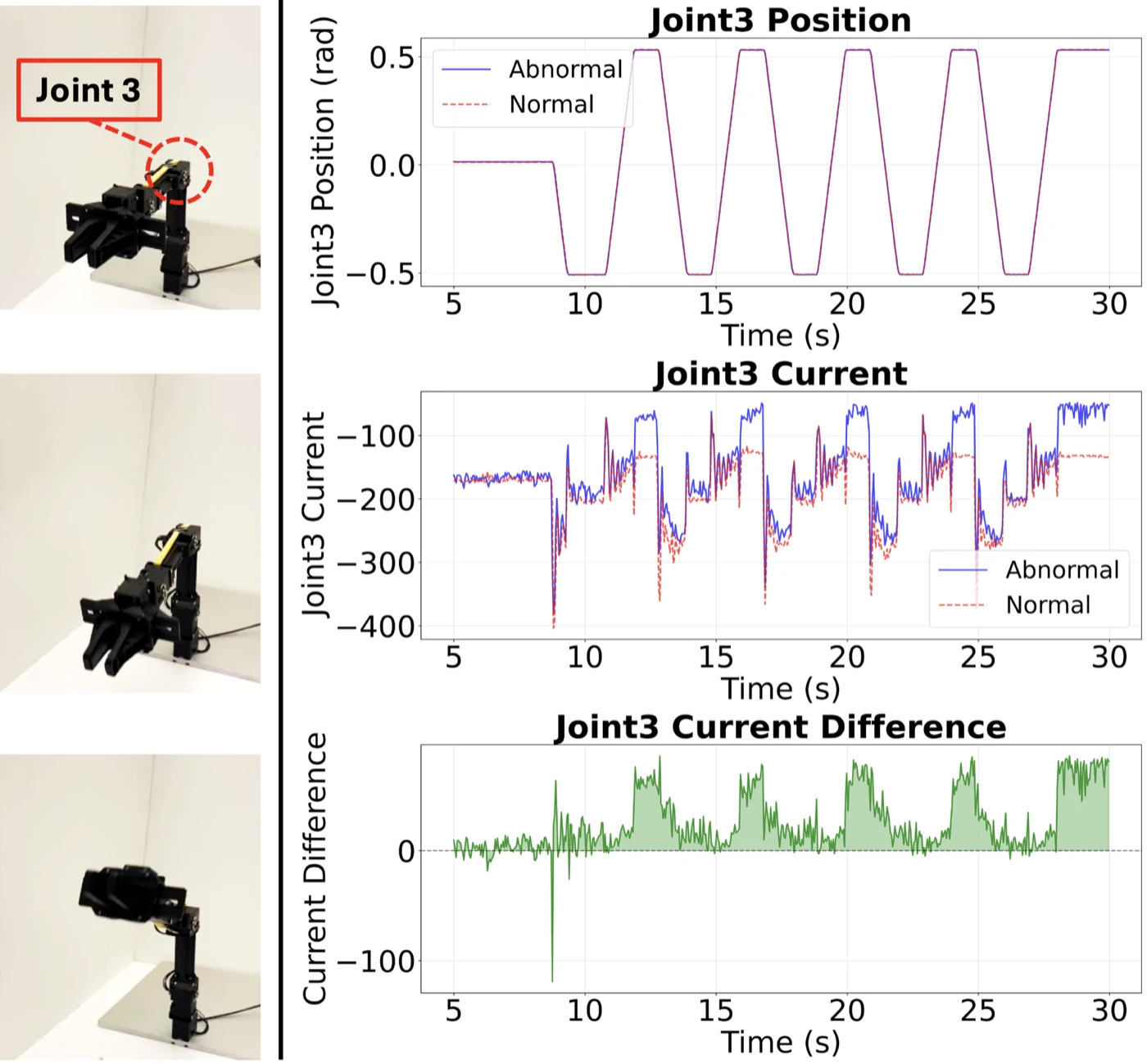
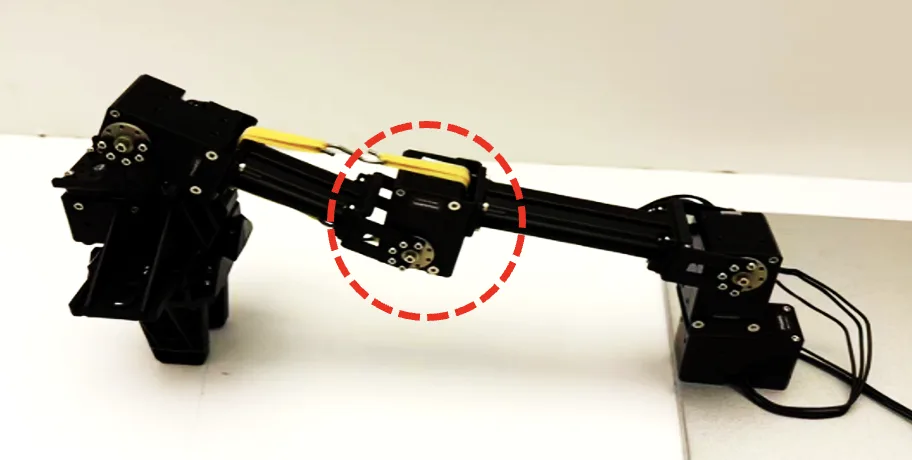
Joint 3 condition classification. Higher is better; bold marks the best value in each column. The supervised score separates unrestricted from mechanically restricted operation in this controlled experiment; it does not diagnose motor damage or assess general motor health.
| Method | Accuracy | Precision | Recall | AUC-ROC |
|---|---|---|---|---|
| Threshold | 58.6% | 0.0% | 0.0% | 0.45 |
| SVM | 59.9% | 52.6% | 31.7% | 0.62 |
| Random Forest | 67.1% | 62.3% | 52.4% | 0.72 |
| NeuralActuator | 91.0% | 84.5% | 96.2% | 0.95 |
Runtime performance. The model is lightweight enough for simulation and real-time control, with sub-millisecond GPU inference latency.
| Metric | Value | Unit | Metric | Value | Unit |
|---|---|---|---|---|---|
| Parameters | 1.44M | - | Mean time | 0.25 | ms |
| FLOPs (forward) | 5.46M | - | P95 time | 0.31 | ms |
| FP32 parameter memory | 5.50 | MiB | Throughput (batch=1) | 4,019 | Hz |
| - | - | - | Throughput (batch=32) | 10,992 | Hz |
Implicit vs. Explicit Force Coupling
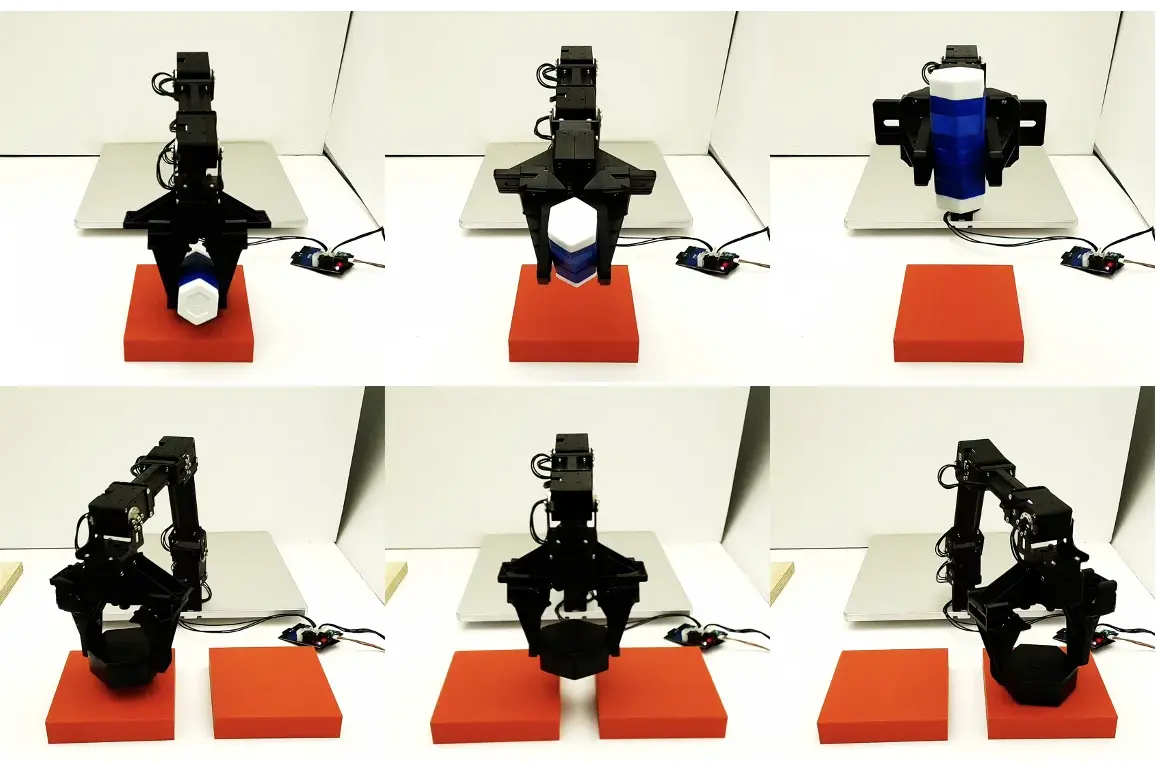
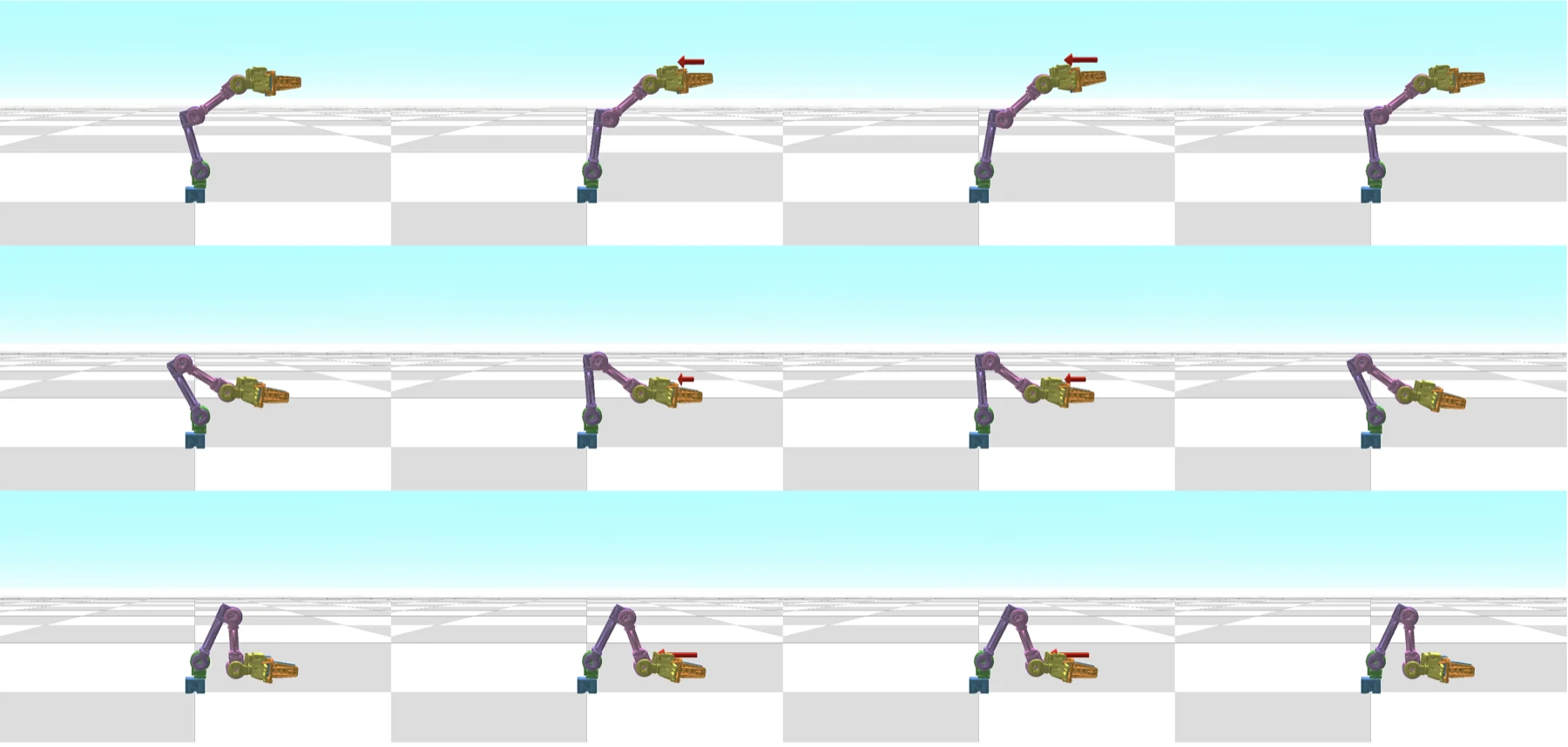
We ablate how the predicted external force is coupled to the differentiable rollout on the combined payload benchmarks. The OpenManipulator-X benchmark combines pick-and-place tasks with 0-500 g payloads and lift-and-hold tasks with 0-400 g payloads; SO-101 follows the six-task payload protocol used in the paper. Implicit coupling drives the simulated body with the torque surrogate alone, whereas explicit coupling additionally applies the predicted force at the end effector. The latter closes the force path inside the simulator but introduces an additional generalized load that the torque-surrogate head must counteract. The animations below verify the explicit injection path using known forces at the grasp point: no applied force on the left, a downward force in the middle, and an upward force on the right.
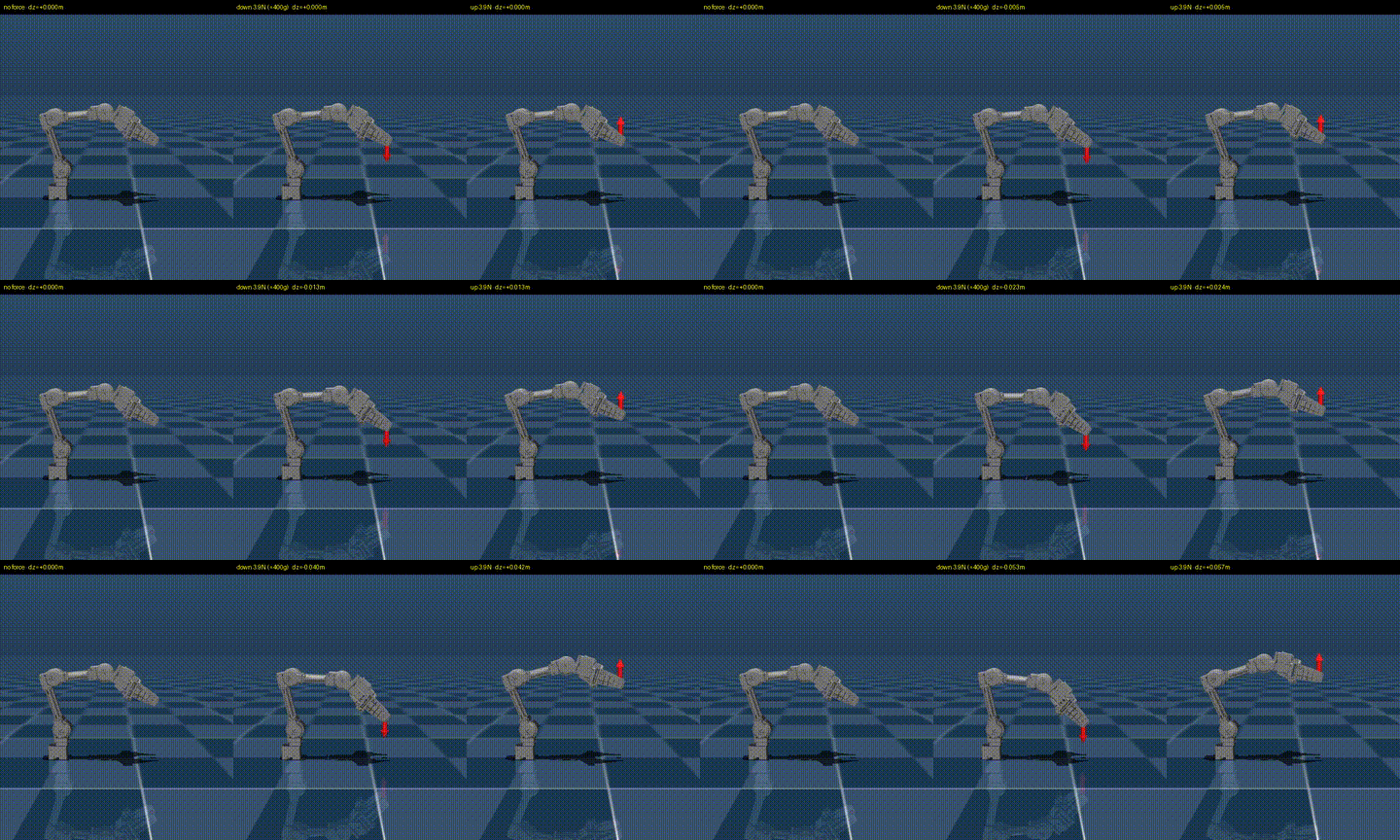
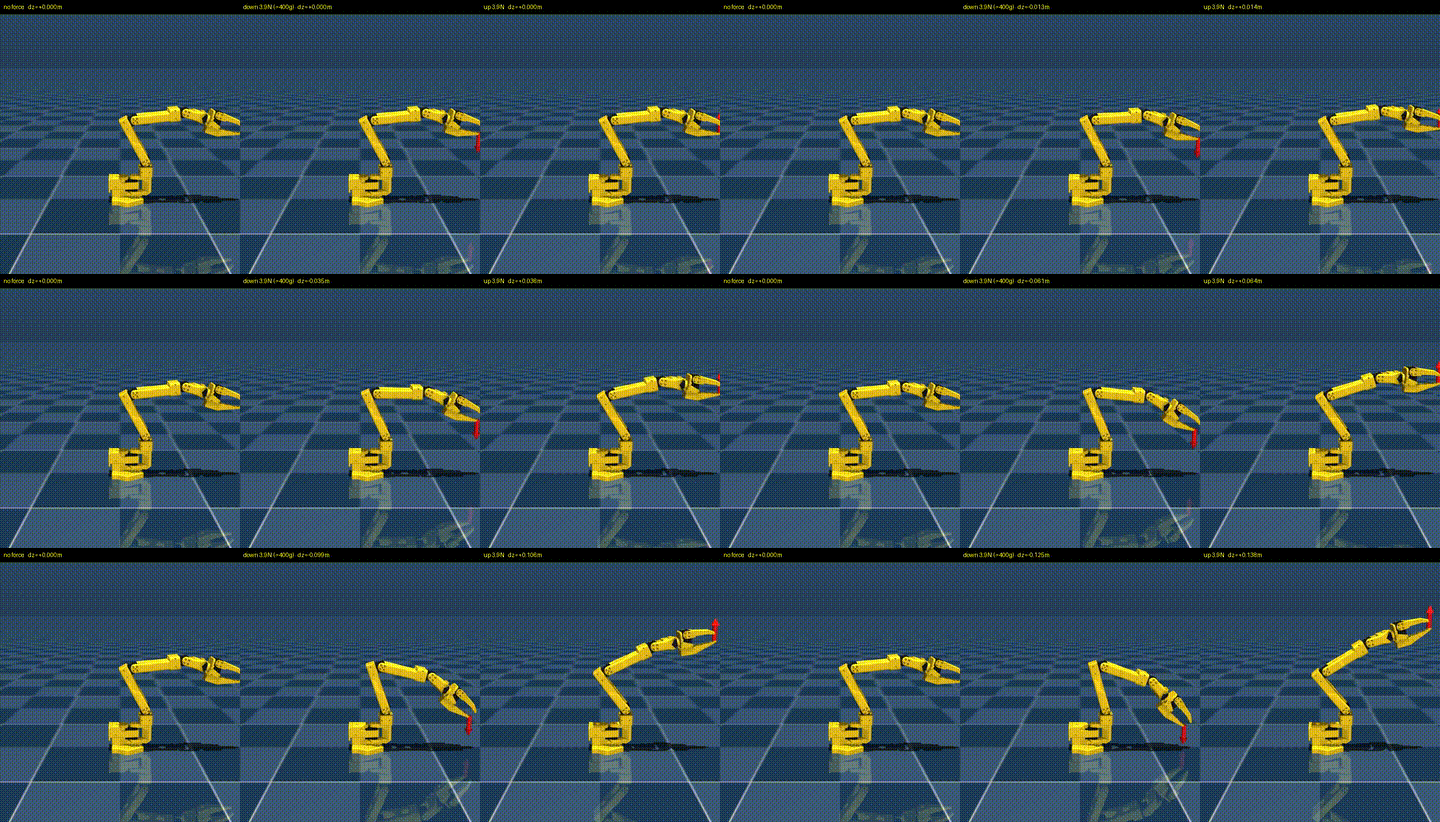
Force-coupling ablation. Joint MAE is the worst task-joint cell and force MAE is the all-task mean. Lower is better; bold marks the best value per metric within each platform. For OpenManipulator-X, joint MAE reports the three-seed mean and range, while force MAE reports the three-seed mean. For SO-101, implicit uses the released checkpoint and explicit summarizes three from-scratch seeds.
| Platform | Coupling | Worst per-joint MAE (deg) | Force MAE (N) |
|---|---|---|---|
| OpenManipulator-X | Implicit | 0.88 (0.84–0.90) | 0.06 |
| OpenManipulator-X | Explicit | 1.33 (1.00–1.53) | 0.08 |
| SO-101 | Implicit | 2.50 | 0.22 |
| SO-101 | Explicit | 6.9 (6.35–7.34) | 0.33 |
Implicit coupling is more accurate on both platforms. The difference is modest on OpenManipulator-X and substantially larger on SO-101, particularly during sustained payload holds. Explicit coupling is more sensitive to mismatch in the force-reference frame, kinematics, and inertial parameters; the resulting uncompensated load can degrade rollout accuracy and force prediction. We therefore use implicit coupling in the paper.
Force-Aware Imitation Learning for Real-Robot Control
Frozen force-perception module for payload-aware behavior cloning.
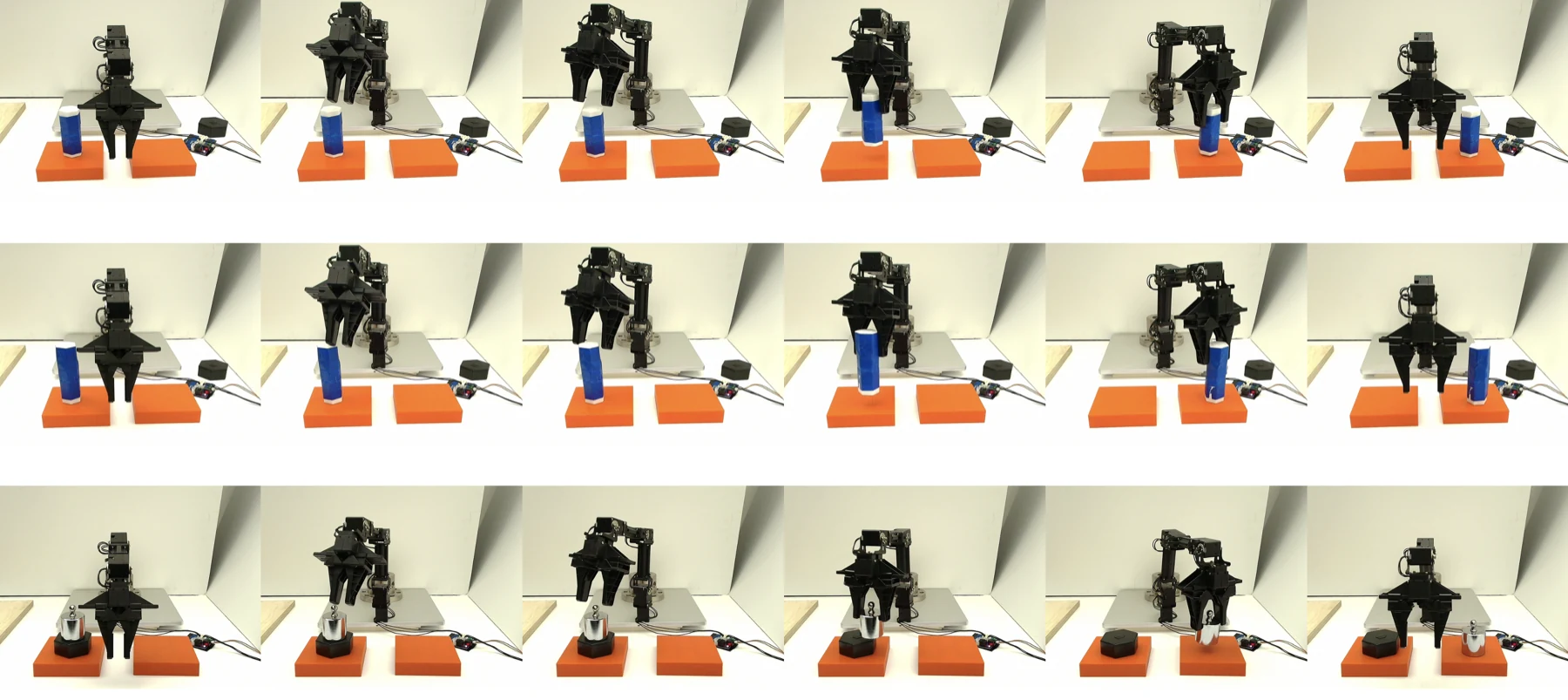
Behavior cloning success rates. Higher is better; bold marks the best value within each task. Both policies are trained from real-robot teleoperation demonstrations and evaluated on hardware. Results are averaged over 40 trials and compare position-only control with a force-aware policy using a frozen pretrained NeuralActuator module.
| Task | Without NeuralActuator | With NeuralActuator |
|---|---|---|
| Pick-and-place | 80% | 92.5% |
| Go up-and-stay | 85% | 95% |
Supporting Results
Cross-platform evaluation, unseen contact geometries, visual supervision, and dataset details.
These results expand the main experiments with platform-specific evaluation, a restricted test on unseen contact geometries, differentiable visual supervision, and the collection details needed to reproduce NAD.
Cross-Platform Evaluation and Surrogate Diagnostics
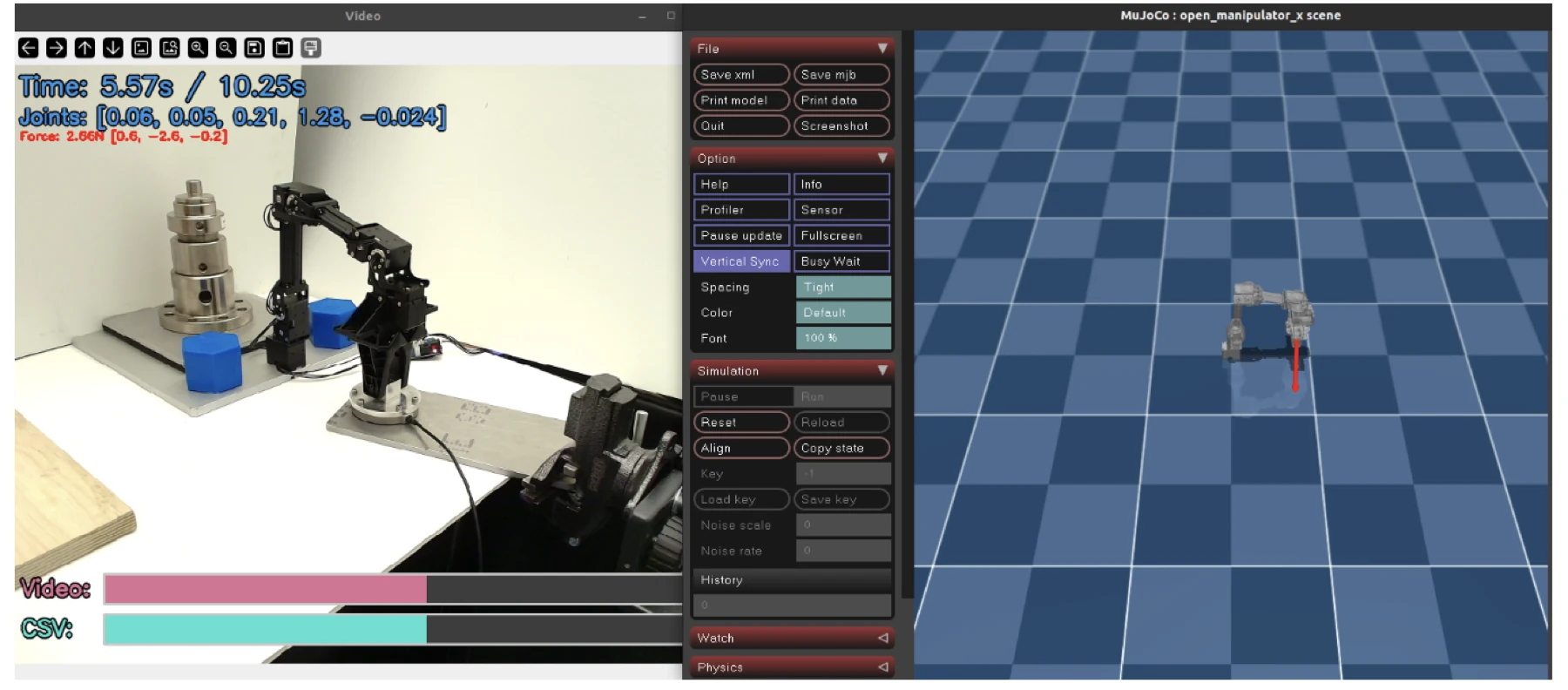
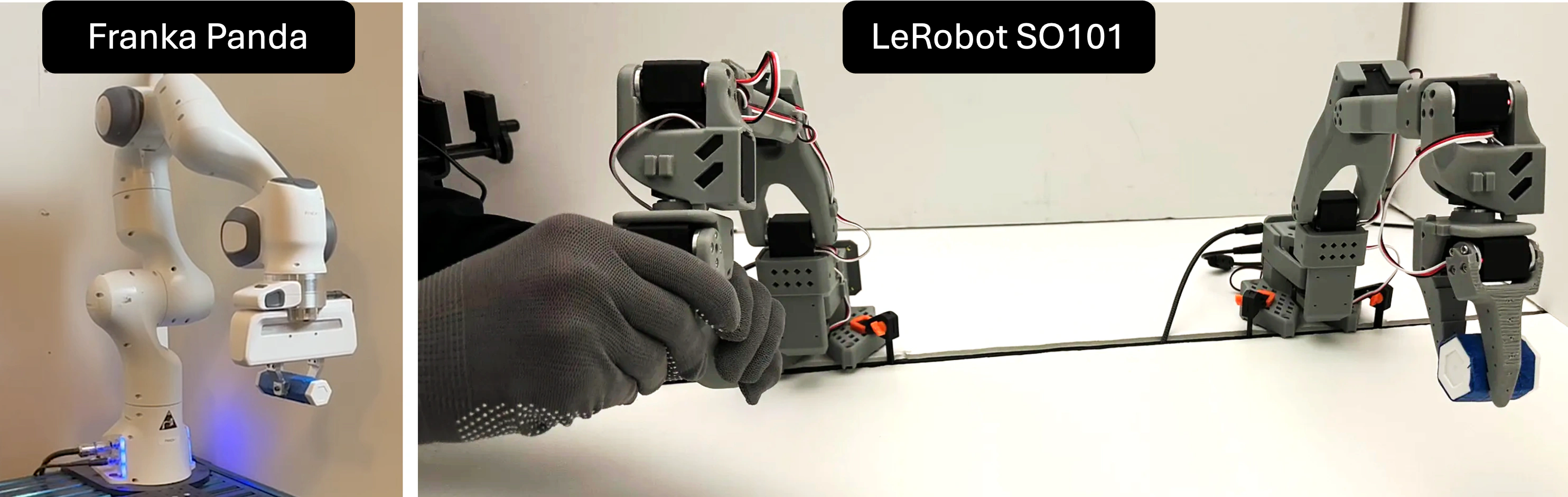
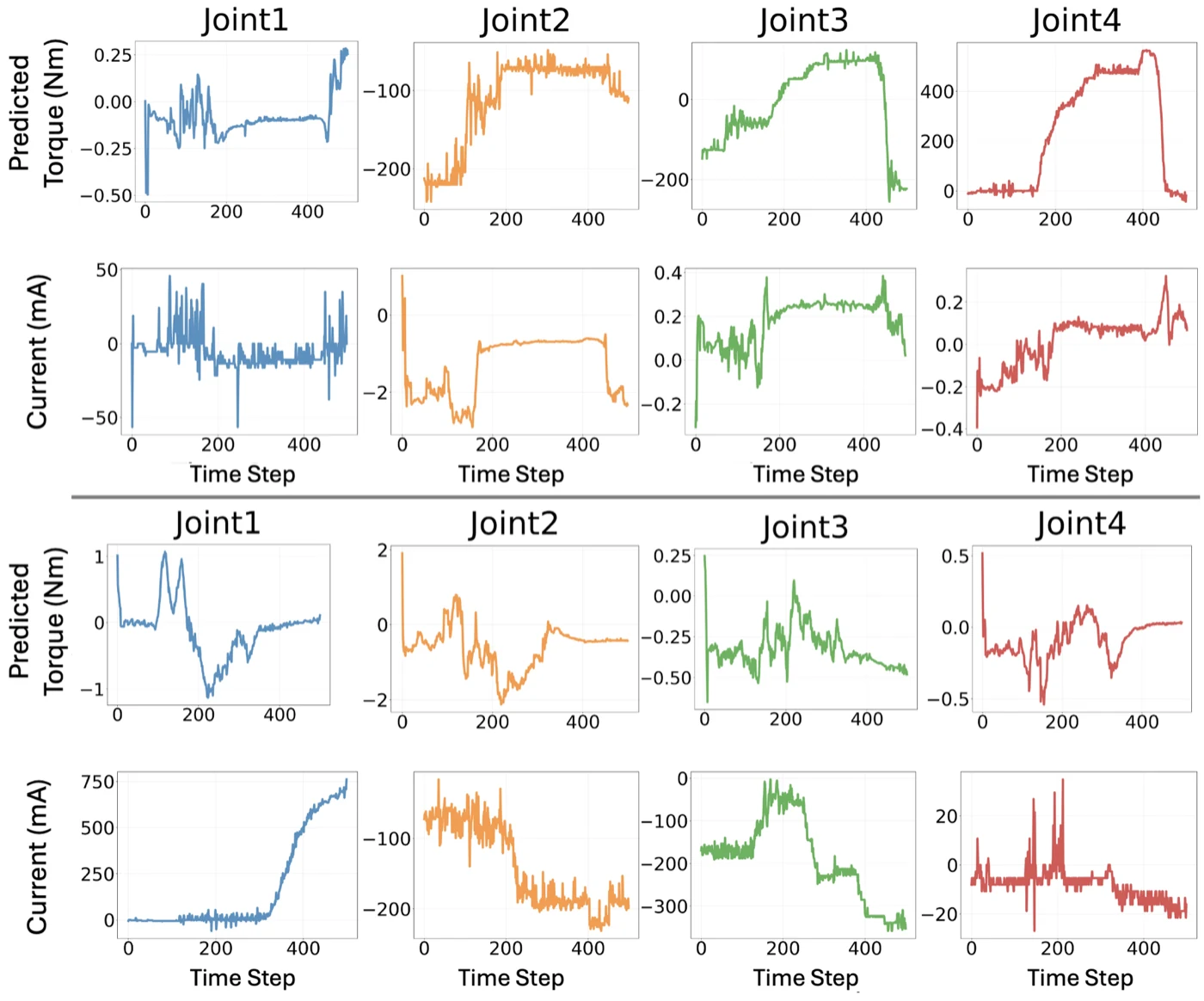
OpenManipulator-X and SO-101 provide rollout and force evaluation on low-cost servo platforms. Franka contributes only a future-state-conditioned offline payload-force-estimation benchmark, not torque or online dynamics validation. On OpenManipulator-X, raw pre-clipping torque-surrogate outputs are compared with measured currents as multivariate, history-conditioned diagnostics rather than as a calibrated current-to-torque relation.
Force Estimation on Unseen Contact Geometries
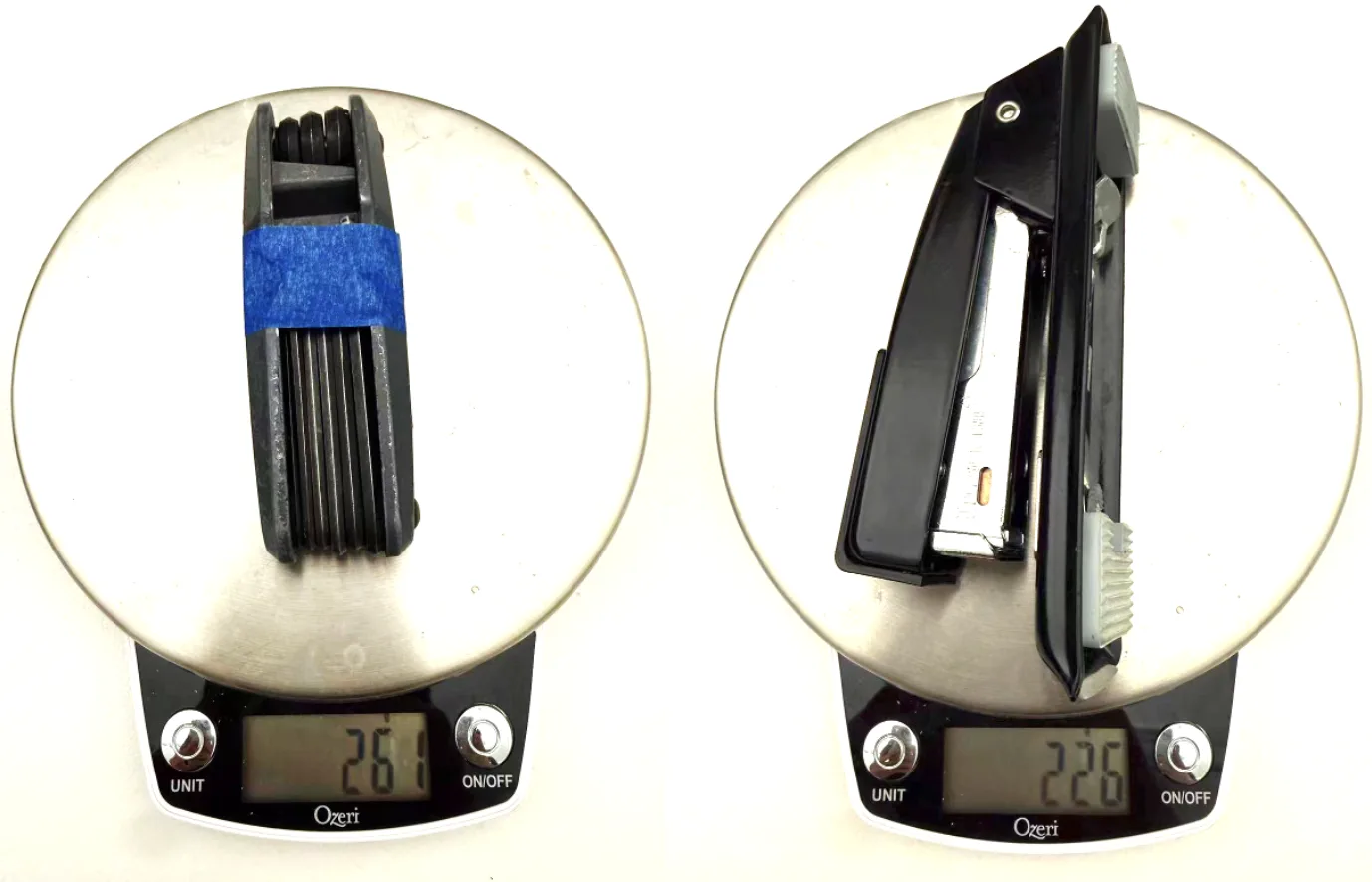
The pretrained force head is evaluated on two objects whose shapes and surface properties are not represented in training. During stationary holding under this restricted setting, it predicts 2.80 N for a 261 g object with 2.56 N ground truth, and 2.40 N for a 226 g object with 2.21 N ground truth. This test probes limited transfer to unseen contact geometries rather than robustness to arbitrary unseen payloads.
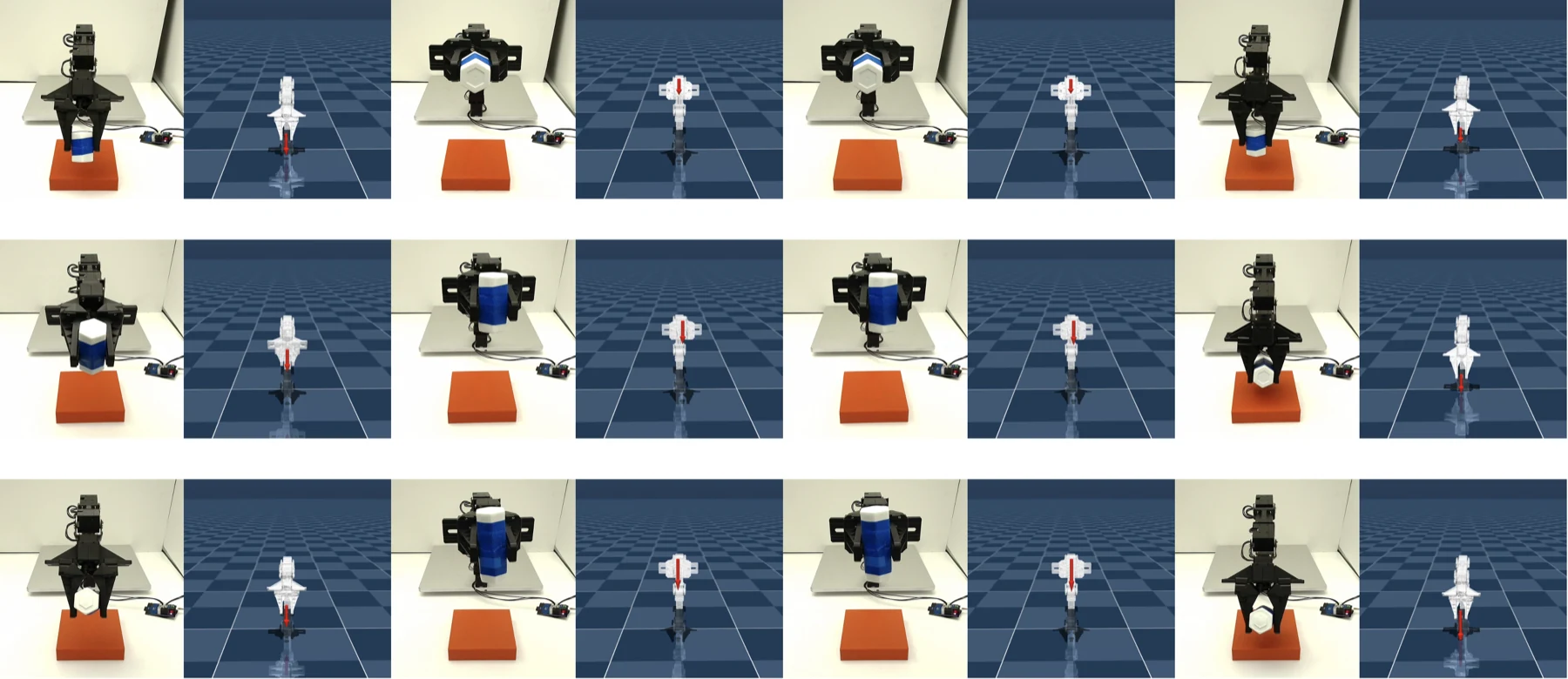
Visual Supervision
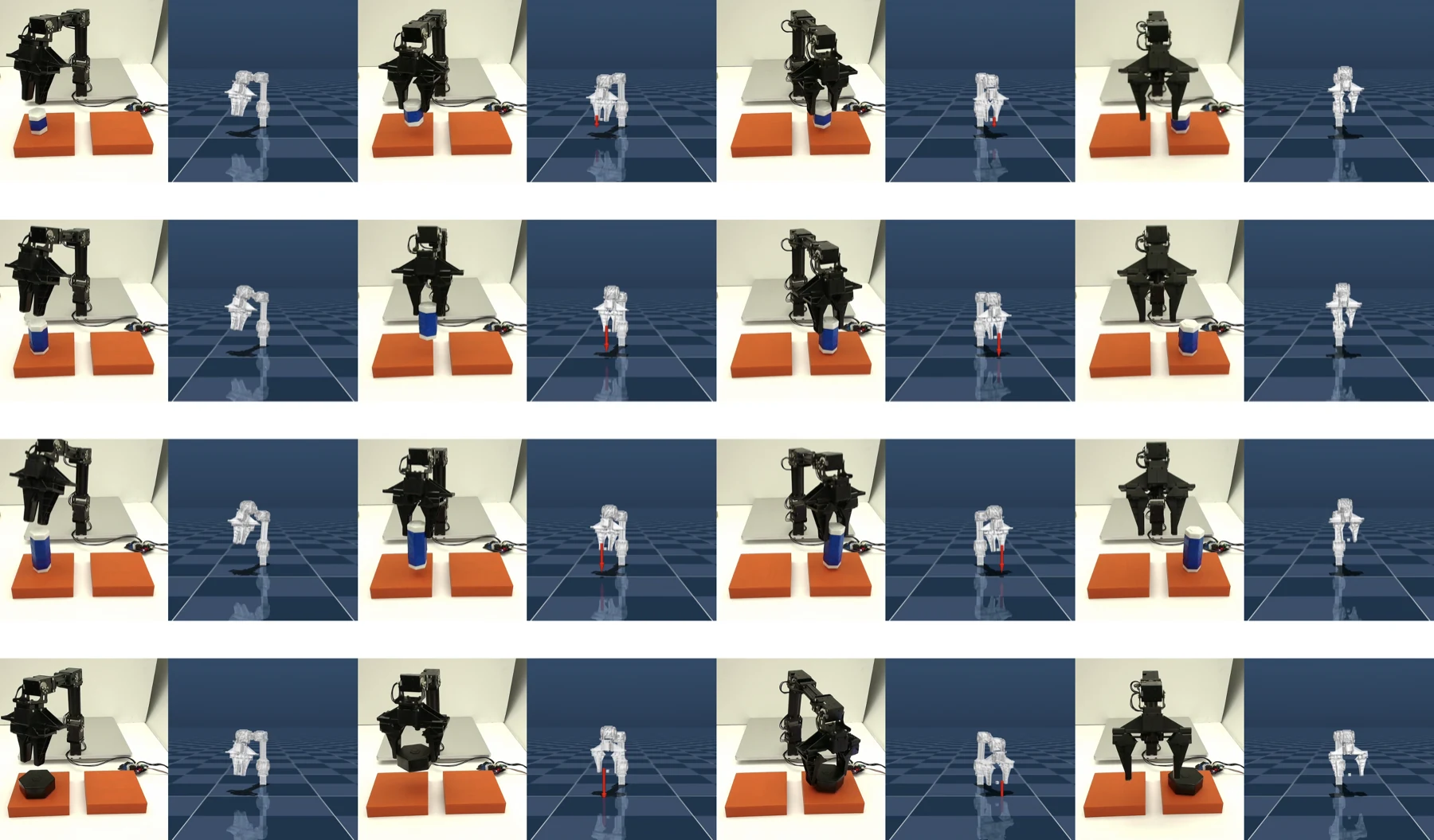
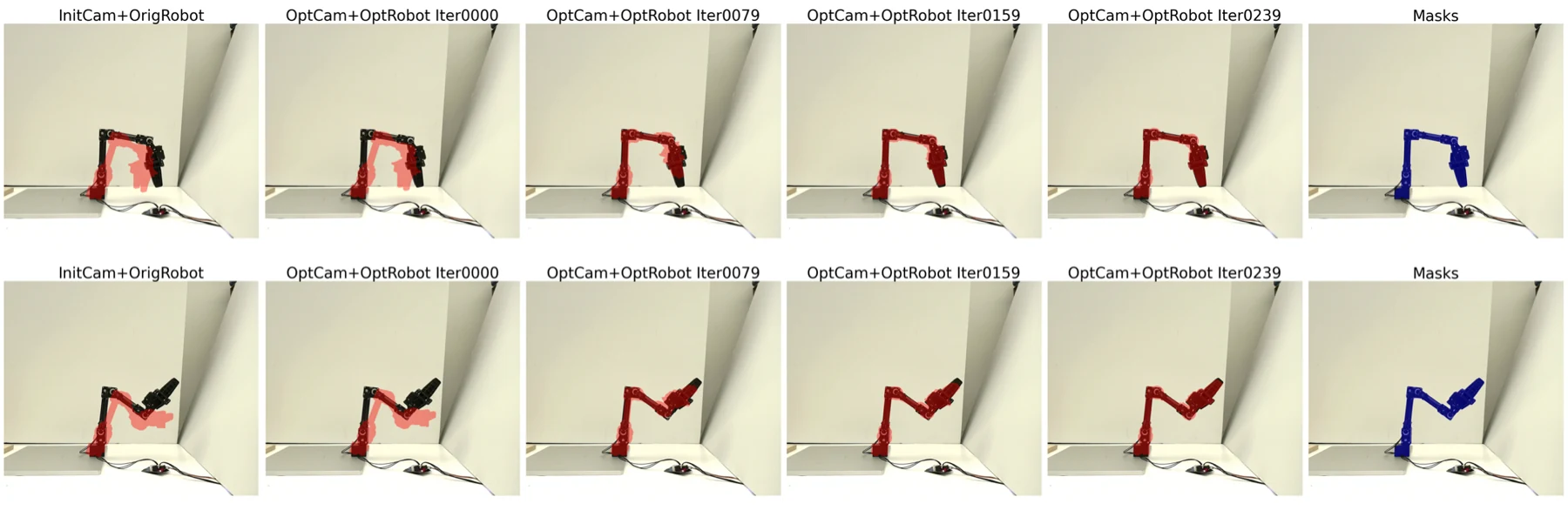
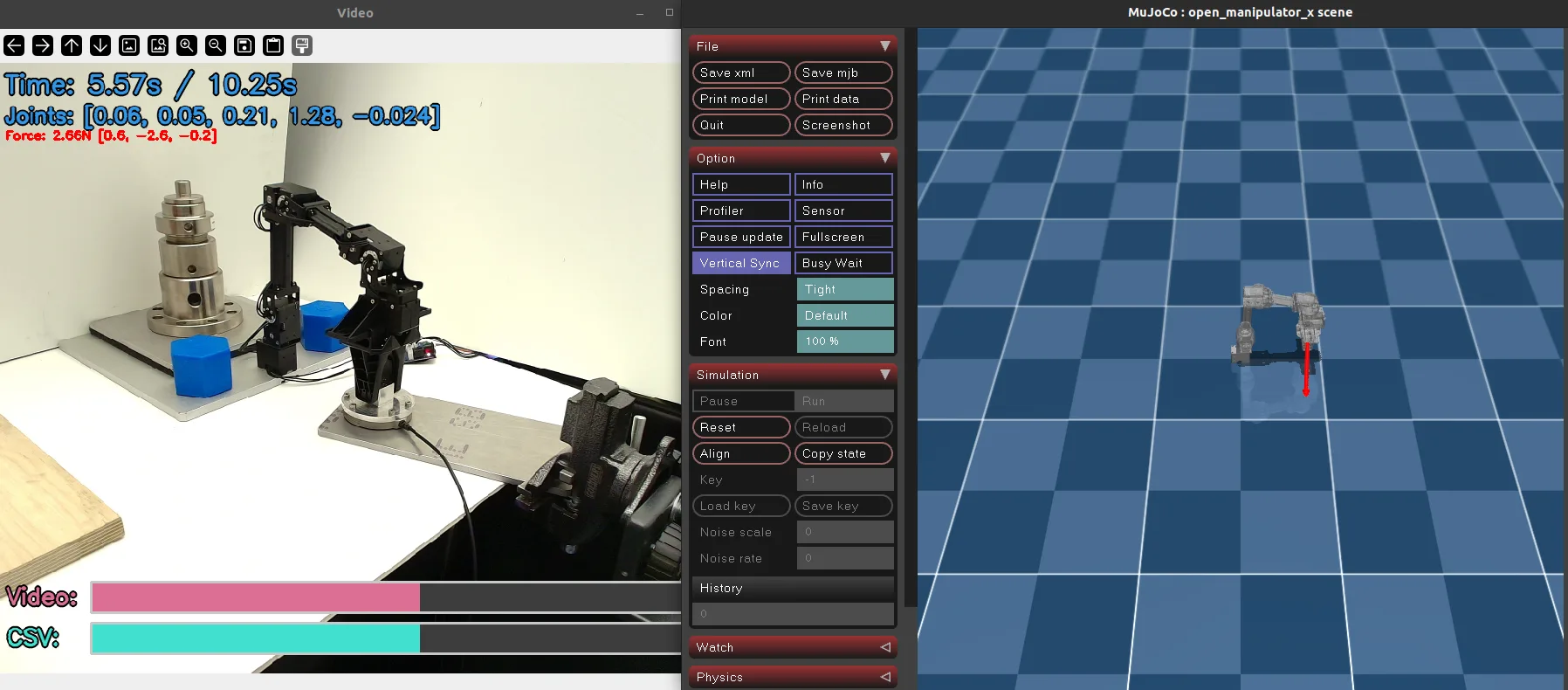
Because the actuator model sits inside a differentiable simulator, it can be combined with differentiable rendering. The visual-supervision example refines camera and robot state by aligning rendered robot silhouettes with image masks.
Dataset and Robot Details
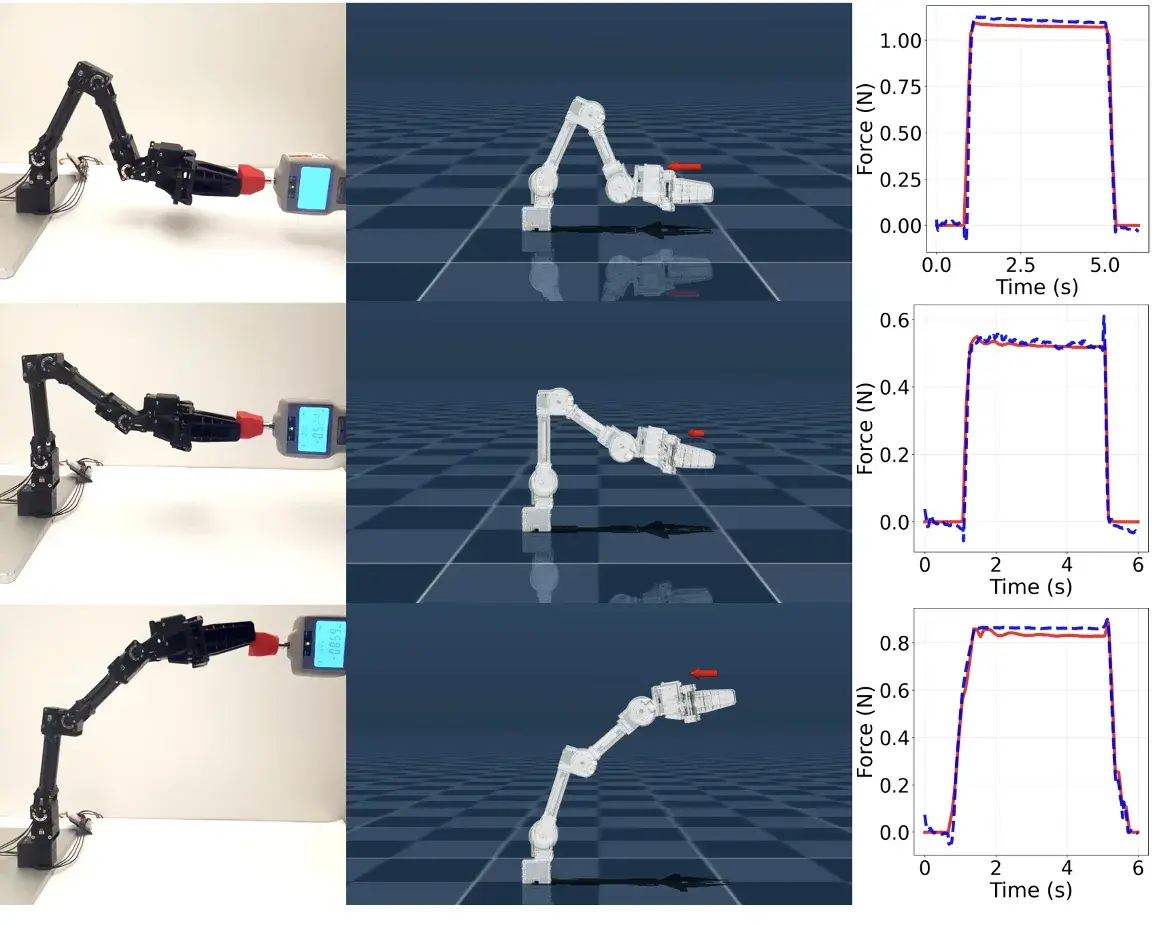
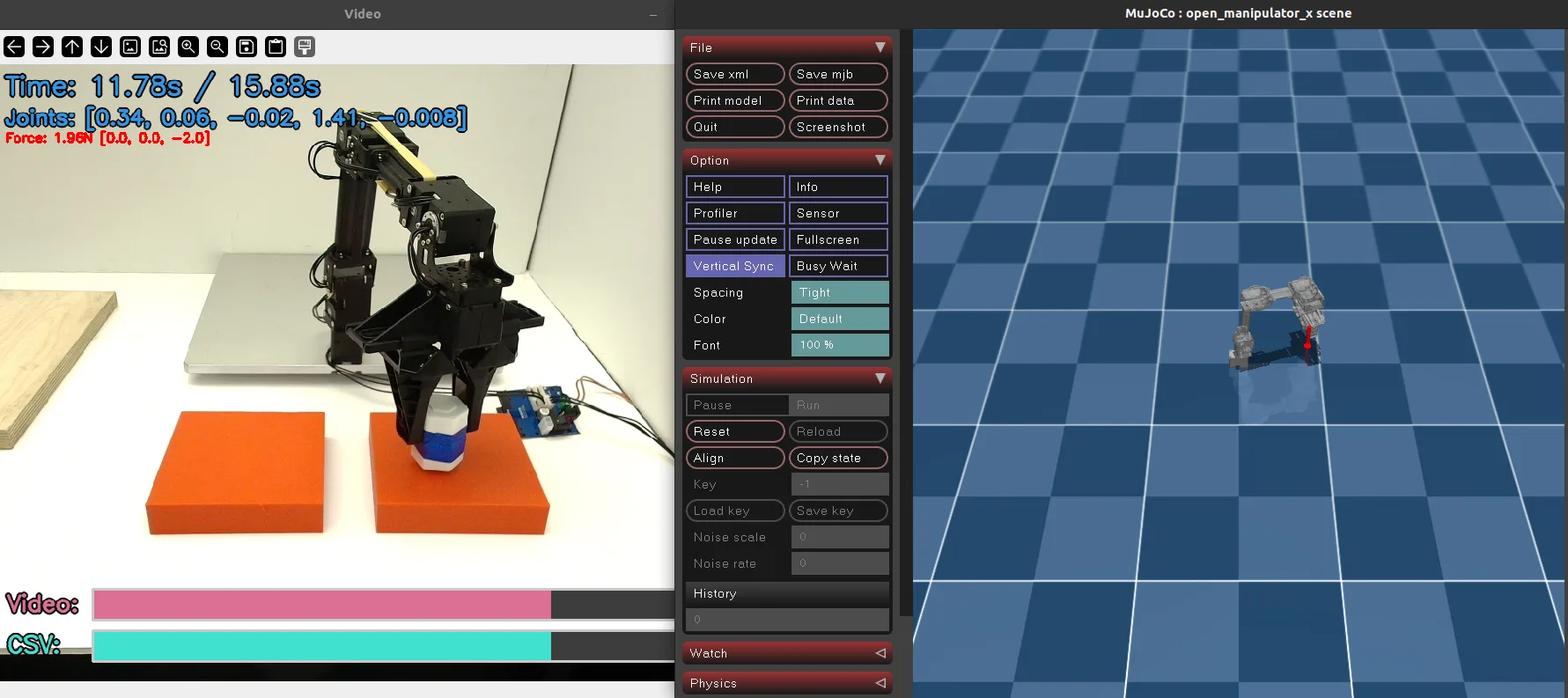
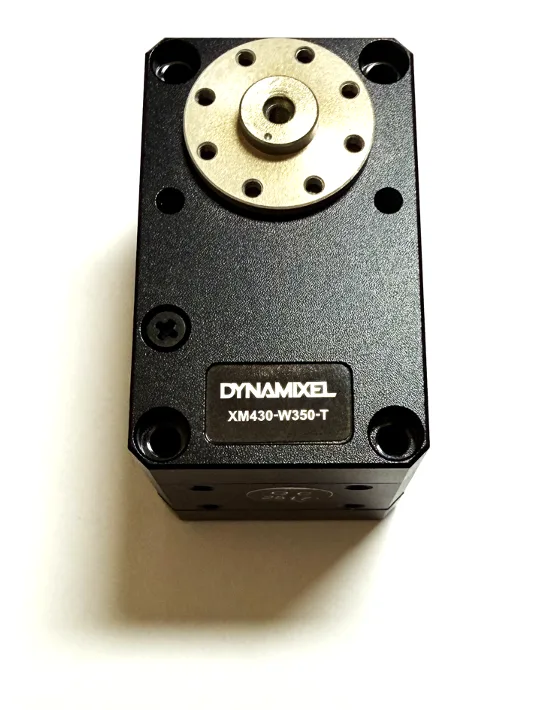
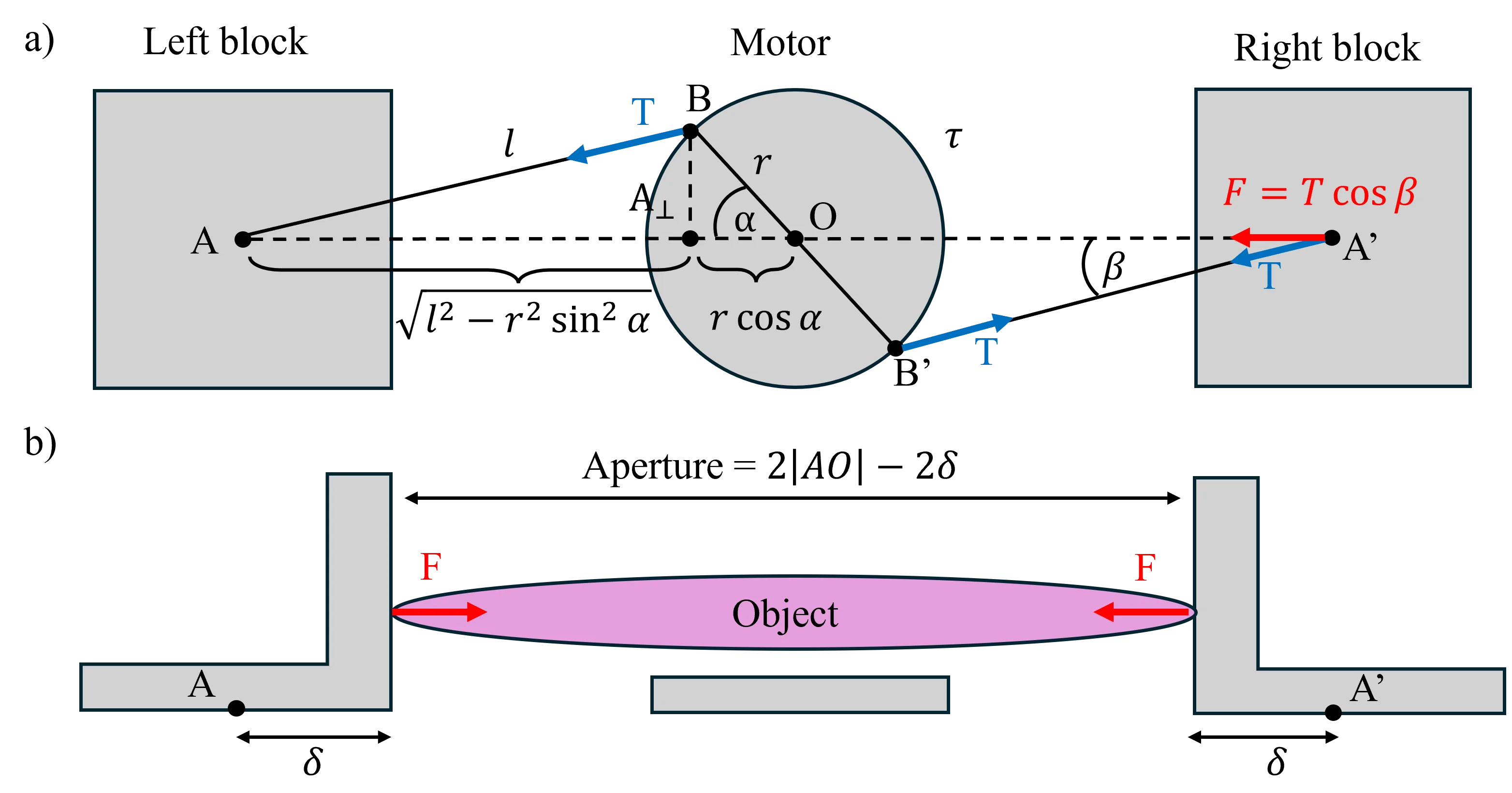
NAD combines leader-follower trajectories, controlled payloads, fixture-mounted force/torque-sensor interactions, and unrestricted or mechanically restricted Joint 3 operation. The force gauge shown with the hardware is used only for the separate gauge-pushing evaluation, not to supervise NAD training samples.
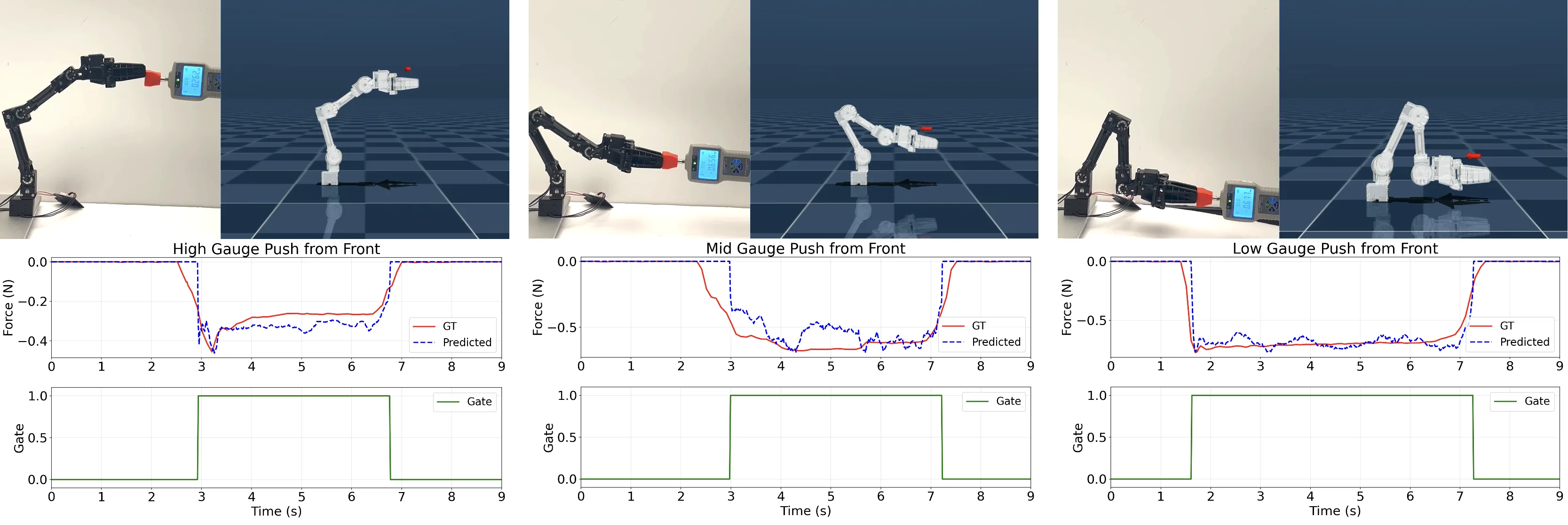
Gauge Pushing
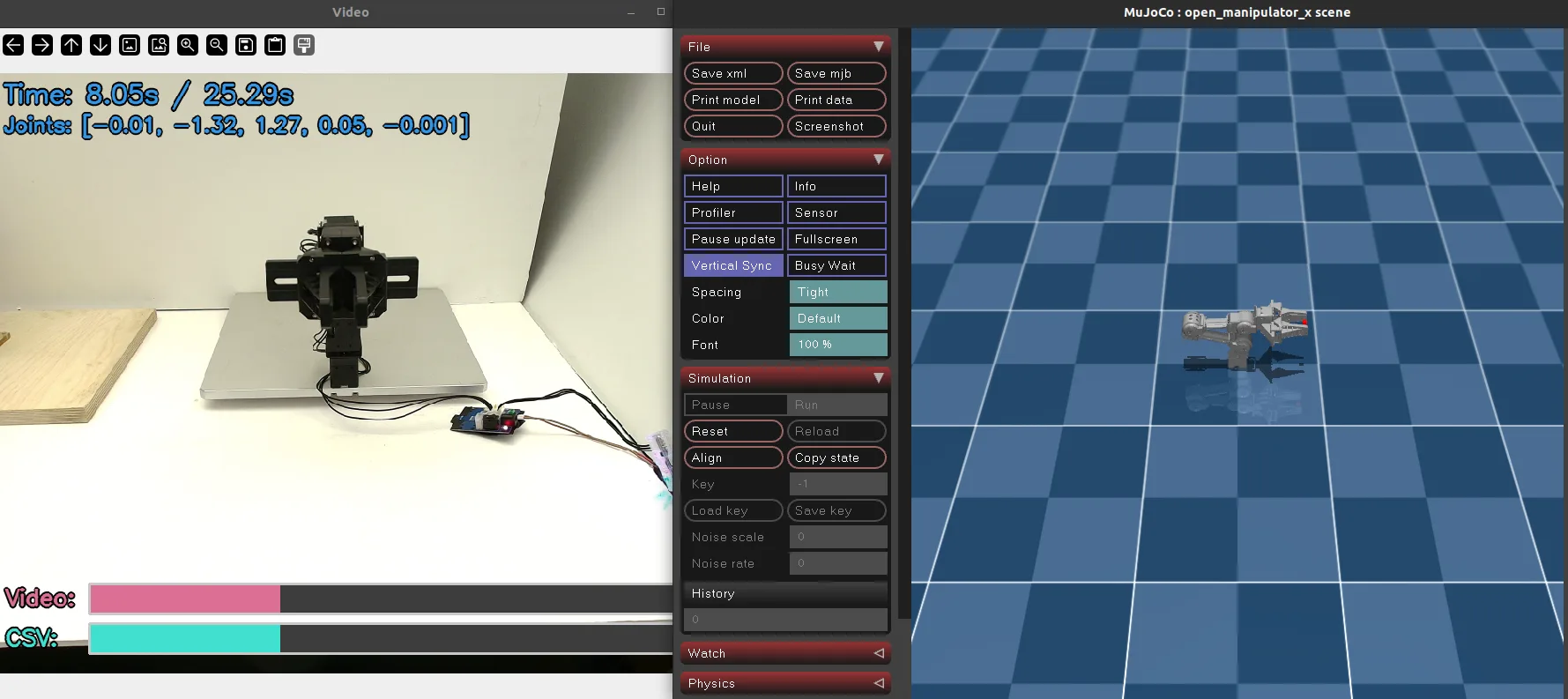
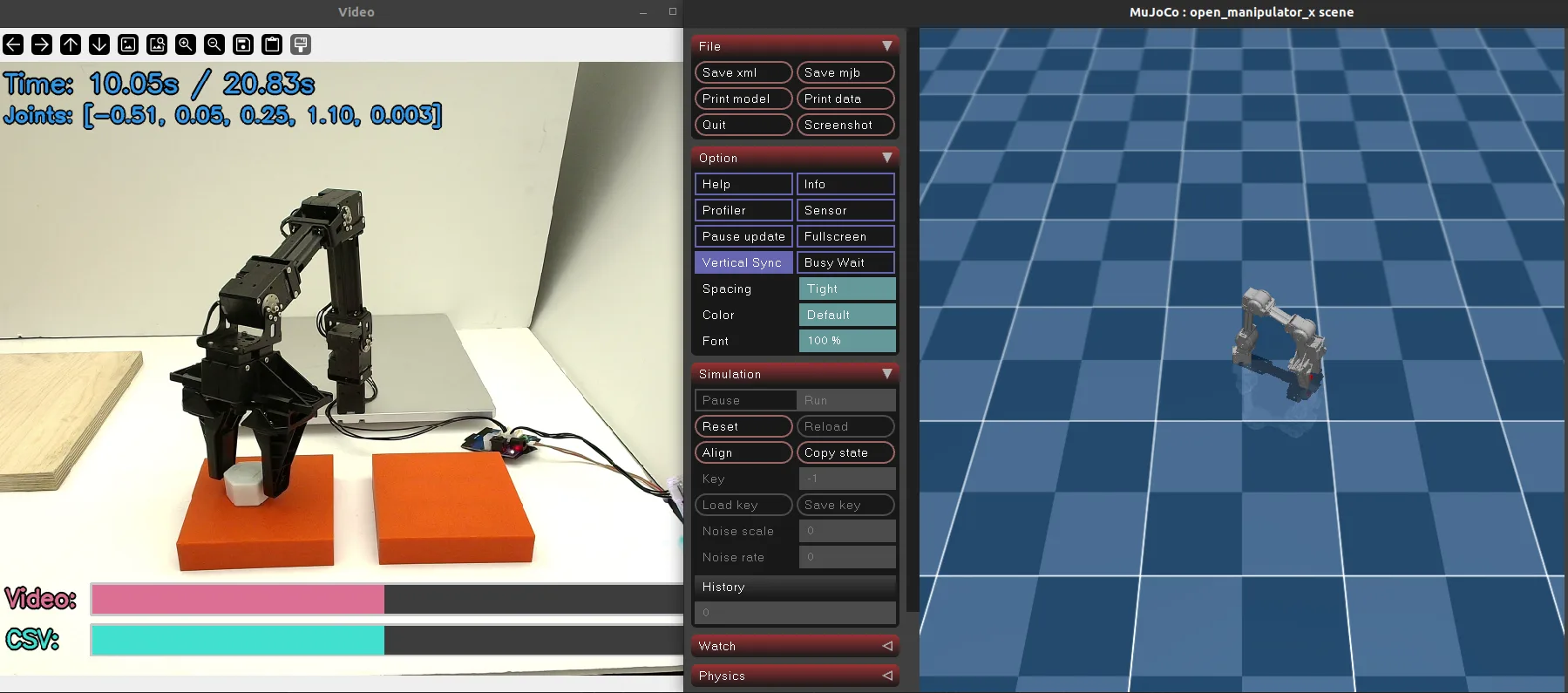
This independent evaluation benchmark is separate from NAD training supervision. It isolates contact transitions from the payload tasks above, and the predicted force tracks the gauge measurement through contact onset, sustained pushing, and release.
Architecture and Adaptation
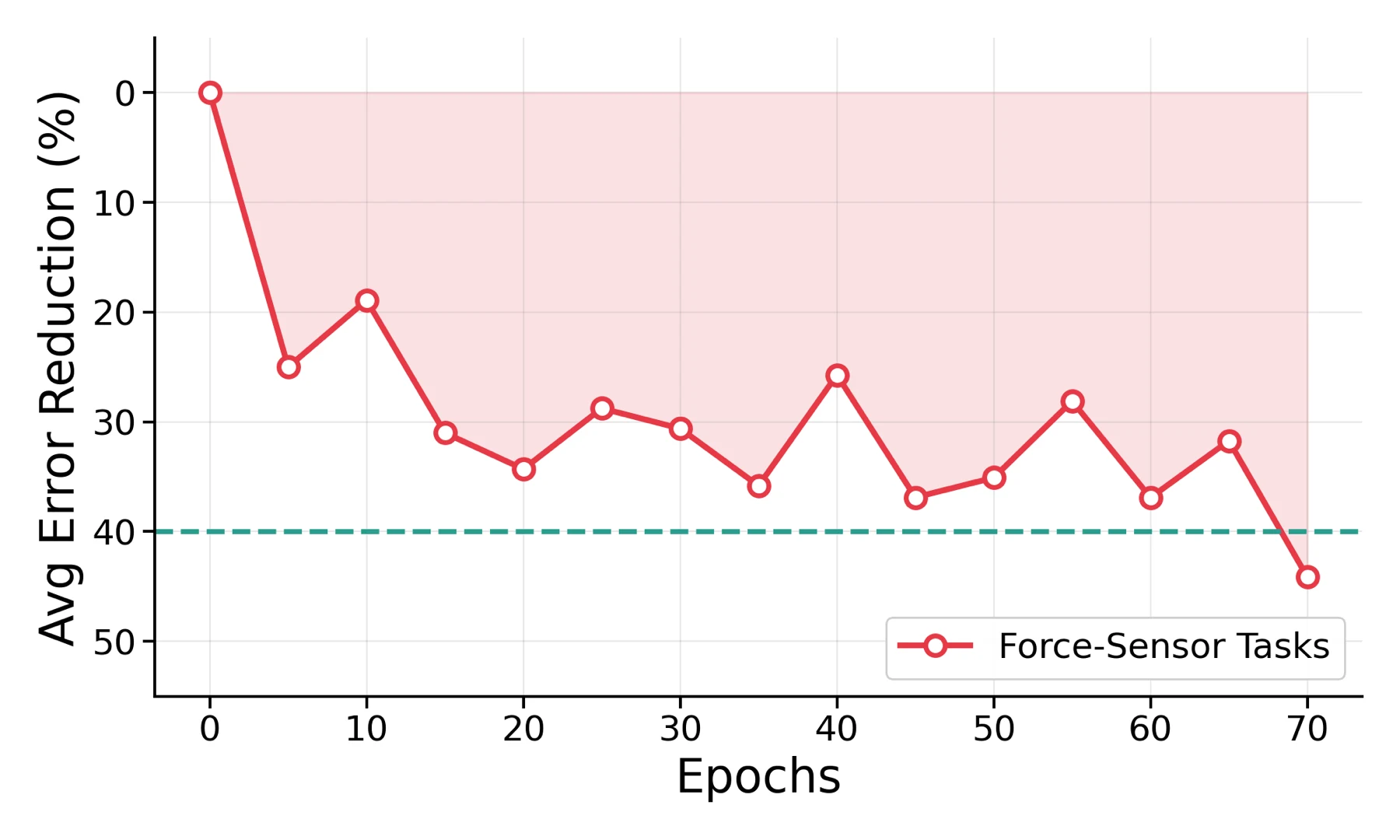
The final checks compare temporal model choices, show rapid online calibration from a small batch of new trajectories, and verify that NeuralActuator can be inserted into another differentiable physics backend.
Architecture ablation. Transformer history modeling improves force prediction while remaining competitive on rollout accuracy. Joint errors are in degrees, Grip is single-finger slide-coordinate MAE in millimeters, and Force is in Newtons. Lower is better; bold marks the best value in each column, including ties at the displayed precision.
| Model | J1 | J2 | J3 | J4 | Grip | Force |
|---|---|---|---|---|---|---|
| MLP | 4.55 | 5.81 | 3.48 | 2.16 | 0.91 | 0.47 |
| GRU | 1.83 | 2.08 | 1.68 | 1.70 | 0.65 | 0.49 |
| LSTM | 2.91 | 7.66 | 3.21 | 3.08 | 0.71 | 0.41 |
| NeuralActuator | 1.78 | 3.31 | 2.01 | 1.58 | 0.65 | 0.23 |
Quantitative Results
Rollout accuracy, force prediction, adaptation, and cross-platform tests.
Dynamics and Force Prediction
Gradient behavior across rollout horizons. Input-grad is the norm of the loss gradient at the simulator's bounded generalized-effort input; cosine similarity is computed against the parameter gradient at H=128.
| H | Input-grad | ||gradθ L|| | Cos. |
|---|---|---|---|
| 64 | 2.73e-2 | 8.77 | 0.96 |
| 128 | 2.59e-2 | 17.33 | 1.00 |
| 256 | 1.72e-2 | 22.35 | 0.99 |
| 320 | 1.45e-2 | 22.91 | 0.99 |
| 500 | 9.37e-3 | 20.29 | 0.98 |
Simulation accuracy on the test set. J1-J4: joint-angle MAE (deg). Grip: single-finger slide-coordinate MAE (mm).
| Task | @100 | @300 | @600 | ||||||||||||
|---|---|---|---|---|---|---|---|---|---|---|---|---|---|---|---|
| J1 | J2 | J3 | J4 | Grip | J1 | J2 | J3 | J4 | Grip | J1 | J2 | J3 | J4 | Grip | |
| backward_forward | 2.4 | 4.3 | 4.4 | 4.2 | 0 | 2.3 | 5.9 | 3.9 | 4.2 | 0 | 3.1 | 4.8 | 4.9 | 4.5 | 0 |
| circular_ccw | 1.7 | 5.2 | 2.2 | 2.6 | 0 | 1.5 | 3.1 | 2.0 | 3.4 | 0 | 2.5 | 2.3 | 2.1 | 2.8 | 0 |
| circular_cw | 3.6 | 3.2 | 1.4 | 2.2 | 0 | 3.1 | 1.9 | 1.2 | 2.6 | 0 | 2.6 | 1.7 | 2.0 | 2.8 | 0 |
| go_up_stay_still | 2.5 | 1.8 | 2.3 | 1.2 | 0 | 3.1 | 2.1 | 3.1 | 2.5 | 0 | 3.1 | 1.5 | 3.5 | 2.7 | 0 |
| joint_sweep_1 | 2.3 | 2.5 | 1.8 | 1.4 | 0 | 1.9 | 1.0 | 2.6 | 1.8 | 0 | 2.9 | 1.9 | 2.0 | 1.6 | 0 |
| joint_sweep_2 | 2.1 | 4.3 | 4.6 | 1.2 | 0 | 1.8 | 6.7 | 8.4 | 1.1 | 0 | 2.4 | 4.6 | 5.2 | 1.7 | 0 |
| joint_sweep_3 | 3.7 | 4.5 | 3.1 | 1.9 | 0 | 3.4 | 2.6 | 2.8 | 2.8 | 0 | 3.1 | 2.6 | 2.5 | 3.4 | 0 |
| joint_sweep_4 | 2.6 | 4.8 | 2.5 | 3.4 | 0 | 2.9 | 3.3 | 2.4 | 3.2 | 0 | 2.4 | 2.9 | 2.2 | 4.6 | 0 |
| joint_sweep_5 | 1.7 | 3.0 | 1.7 | 3.1 | 0.4 | 2.6 | 3.9 | 2.3 | 2.7 | 0.5 | 5.5 | 3.3 | 5.1 | 3.0 | 0.7 |
| pick_place_empty | 2.6 | 2.5 | 2.2 | 3.5 | 1.1 | 1.9 | 3.6 | 2.7 | 3.2 | 1.1 | 3.1 | 2.7 | 2.0 | 3.9 | 1.0 |
| Average | 2.5 | 3.6 | 2.6 | 2.5 | 0.2 | 2.5 | 3.4 | 3.1 | 2.8 | 0.2 | 3.1 | 2.8 | 3.2 | 3.1 | 0.2 |
Simulation and force prediction accuracy on the force-sensor test set. F: force MAE (N).
| Task | @100 | @300 | @500 | |||||||||||||||
|---|---|---|---|---|---|---|---|---|---|---|---|---|---|---|---|---|---|---|
| J1 | J2 | J3 | J4 | Grip | F | J1 | J2 | J3 | J4 | Grip | F | J1 | J2 | J3 | J4 | Grip | F | |
| force_X+ | 0.9 | 2.3 | 0.9 | 1.6 | 1.0 | 0.36 | 1.1 | 1.8 | 2.4 | 1.3 | 1.0 | 0.46 | 0.9 | 1.9 | 2.7 | 1.7 | 1.0 | 0.50 |
| force_X- | 1.4 | 1.1 | 0.8 | 1.1 | 1.0 | 0.39 | 1.6 | 2.3 | 1.3 | 2.3 | 1.0 | 0.42 | 2.0 | 2.9 | 1.5 | 3.0 | 1.0 | 0.44 |
| force_Y+ | 2.3 | 5.7 | 2.8 | 0.6 | 0.1 | 0.36 | 2.1 | 4.5 | 2.6 | 0.9 | 0.2 | 0.38 | 2.7 | 4.8 | 2.1 | 0.9 | 0.3 | 0.44 |
| force_Y- | 1.4 | 1.6 | 3.1 | 0.5 | 0.1 | 0.38 | 1.5 | 3.0 | 3.1 | 1.3 | 0.1 | 0.36 | 1.4 | 3.6 | 3.1 | 1.5 | 0.2 | 0.38 |
| force_Z+ | 3.3 | 6.2 | 3.3 | 0.8 | 0.1 | 0.39 | 2.3 | 5.6 | 2.5 | 1.9 | 0.2 | 0.43 | 2.5 | 4.4 | 2.2 | 2.3 | 0.3 | 0.46 |
| force_Z- | 1.0 | 5.9 | 0.6 | 0.6 | 1.0 | 0.36 | 2.9 | 6.6 | 2.8 | 2.5 | 1.0 | 0.64 | 3.8 | 6.4 | 3.5 | 2.0 | 1.0 | 0.57 |
| ref_X+ | 0.6 | 2.0 | 1.5 | 1.2 | 1.0 | 0.01 | 0.8 | 1.8 | 1.0 | 1.1 | 1.0 | 0.02 | 1.0 | 1.6 | 1.1 | 1.1 | 1.0 | 0.01 |
| ref_X- | 2.0 | 2.5 | 0.5 | 1.1 | 1.0 | 0.00 | 1.4 | 2.3 | 0.5 | 1.0 | 1.0 | 0.00 | 1.5 | 2.2 | 0.8 | 1.3 | 1.0 | 0.00 |
| ref_Y+ | 2.0 | 1.0 | 2.0 | 0.6 | 0.1 | 0.00 | 2.1 | 3.3 | 2.1 | 1.1 | 0.2 | 0.00 | 1.9 | 3.7 | 1.7 | 1.1 | 0.4 | 0.00 |
| ref_Y- | 1.0 | 1.8 | 1.2 | 1.3 | 0.1 | 0.00 | 1.6 | 4.5 | 2.0 | 2.2 | 0.1 | 0.00 | 1.2 | 4.0 | 2.4 | 1.6 | 0.3 | 0.00 |
| ref_Z+ | 1.2 | 1.7 | 2.1 | 0.5 | 0.1 | 0.00 | 1.6 | 3.8 | 2.2 | 1.2 | 0.2 | 0.00 | 1.5 | 2.9 | 2.0 | 1.3 | 0.3 | 0.00 |
| ref_Z- | 0.6 | 2.3 | 0.9 | 0.9 | 1.0 | 0.02 | 0.7 | 1.6 | 1.1 | 1.1 | 1.0 | 0.01 | 0.9 | 1.3 | 1.0 | 1.1 | 1.0 | 0.01 |
| Avg | 1.48 | 2.84 | 1.64 | 0.90 | 0.55 | 0.19 | 1.64 | 3.43 | 1.97 | 1.49 | 0.58 | 0.23 | 1.78 | 3.31 | 2.01 | 1.58 | 0.65 | 0.23 |
Simulation and force prediction accuracy on the weight-based test set.
| Task | Weight | @100 | @300 | @600 | |||||||||||||||
|---|---|---|---|---|---|---|---|---|---|---|---|---|---|---|---|---|---|---|---|
| J1 | J2 | J3 | J4 | Grip | F | J1 | J2 | J3 | J4 | Grip | F | J1 | J2 | J3 | J4 | Grip | F | ||
| go up and stay | 200g | 1.3 | 5.0 | 2.6 | 2.4 | 0.1 | 0.12 | 3.4 | 3.9 | 4.2 | 2.3 | 0.1 | 0.10 | 3.1 | 3.3 | 4.3 | 2.9 | 0.1 | 0.16 |
| go up and stay | 300g | 2.6 | 5.3 | 5.7 | 3.7 | 0.1 | 0.20 | 1.8 | 3.4 | 5.7 | 5.4 | 0.0 | 0.17 | 3.5 | 2.5 | 3.4 | 4.6 | 0.0 | 0.20 |
| go up and stay | 400g | 2.2 | 4.1 | 1.4 | 5.0 | 0.1 | 0.07 | 2.9 | 2.1 | 2.1 | 6.1 | 0.1 | 0.12 | 2.0 | 1.4 | 3.0 | 7.1 | 0.2 | 0.11 |
| pick and place | 200g | 0.7 | 3.1 | 4.3 | 3.4 | 1.1 | 0.24 | 2.7 | 3.9 | 4.0 | 4.0 | 1.1 | 0.08 | 2.9 | 5.1 | 2.9 | 3.0 | 1.0 | 0.11 |
| pick and place | 300g | 0.5 | 4.5 | 3.7 | 0.9 | 0.3 | 0.00 | 1.2 | 5.1 | 4.8 | 1.5 | 0.2 | 0.00 | 2.7 | 7.8 | 4.9 | 3.2 | 0.3 | 0.09 |
| pick and place | 400g | 0.8 | 2.1 | 2.8 | 2.9 | 1.1 | 0.19 | 2.8 | 1.4 | 3.4 | 3.6 | 1.1 | 0.06 | 2.4 | 2.0 | 3.8 | 3.3 | 1.0 | 0.03 |
| pick and place | 500g | 2.7 | 1.8 | 1.7 | 3.3 | 1.1 | 0.05 | 4.8 | 2.8 | 1.7 | 2.3 | 1.1 | 0.02 | 4.2 | 6.3 | 2.3 | 2.3 | 0.9 | 0.04 |
| Avg | 1.54 | 3.70 | 3.17 | 3.09 | 0.56 | 0.12 | 2.80 | 3.23 | 3.70 | 3.60 | 0.53 | 0.08 | 2.97 | 4.06 | 3.51 | 3.77 | 0.50 | 0.11 | |
Dataset and Adaptation
Full NAD trajectory accounting. NAD contains 350 OpenManipulator-X task assignments and 100 SO-101 task assignments, for 450 assignments in total. Twenty nominal OpenManipulator-X condition assignments reuse trajectories listed in other categories, leaving 430 distinct trajectories. The OpenManipulator-X table below includes the full 100-500 g payload range; the earlier 94.52-minute summary covers only the model-development and evaluation subset used in the reported experiments.
| Category | Task | Variant | #Frames | Duration (s) |
|---|---|---|---|---|
| Free motion | Circular trajectory | Clockwise | 8615 | 147.06 |
| Free motion | Circular trajectory | Counterclockwise | 8428 | 143.90 |
| Free motion | Joint sweep | Motor 1 | 22935 | 392.04 |
| Free motion | Joint sweep | Motor 2 | 8688 | 148.47 |
| Free motion | Joint sweep | Motor 3 | 11357 | 193.95 |
| Free motion | Joint sweep | Motor 4 | 15012 | 256.57 |
| Free motion | Joint sweep | Motor 5 | 7338 | 125.21 |
| Free motion | Lean back and extend forward | 12261 | 209.35 | |
| Free motion | Pick & place (empty) | 15288 | 261.08 | |
| Free motion | Go up and stay still | 10011 | 171.14 | |
| Force-labeled | Go up and stay still | 100g | 10976 | 187.61 |
| Force-labeled | Go up and stay still | 200g | 10606 | 181.26 |
| Force-labeled | Go up and stay still | 300g | 11259 | 192.40 |
| Force-labeled | Go up and stay still | 400g | 11291 | 192.89 |
| Force-labeled | Pick and place | 100g | 12483 | 213.35 |
| Force-labeled | Pick and place | 200g | 13245 | 226.15 |
| Force-labeled | Pick and place | 300g | 13129 | 224.31 |
| Force-labeled | Pick and place | 400g | 15124 | 258.54 |
| Force-labeled | Pick and place | 500g | 13957 | 238.49 |
| Force-labeled | Force sensor | +X | 5005 | 85.17 |
| Force-labeled | Force sensor | +X w/o interaction | 5005 | 85.21 |
| Force-labeled | Force sensor | -X | 5169 | 87.94 |
| Force-labeled | Force sensor | -X w/o interaction | 5169 | 88.00 |
| Force-labeled | Force sensor | +Y | 7444 | 126.74 |
| Force-labeled | Force sensor | +Y w/o interaction | 7444 | 126.78 |
| Force-labeled | Force sensor | -Y | 6921 | 117.88 |
| Force-labeled | Force sensor | -Y w/o interaction | 6921 | 117.91 |
| Force-labeled | Force sensor | +Z | 6906 | 117.59 |
| Force-labeled | Force sensor | +Z w/o interaction | 6906 | 117.63 |
| Force-labeled | Force sensor | -Z | 5565 | 94.69 |
| Force-labeled | Force sensor | -Z w/o interaction | 5565 | 94.73 |
| Motor condition | Pick & place w/ weight | Mechanically restricted | 10113 | 168.26 |
| Motor condition | Pick & place w/ weight | Unrestricted operation | 13245 | 226.15 |
| Motor condition | Pick & place w/o weight | Mechanically restricted | 11252 | 192.41 |
| Motor condition | Pick & place w/o weight | Unrestricted operation | 15288 | 261.08 |
Visual-supervision and architecture settings.
| Group | Metric / Model | Value 1 | Value 2 | Value 3 | Value 4 | Value 5 |
|---|---|---|---|---|---|---|
| Silhouette IoU | Initialization | Mean 0.2589 | Std 0.0441 | |||
| Silhouette IoU | Robot refinement | Mean 0.2974 | Std 0.0754 | |||
| Silhouette IoU | Joint refinement | Mean 0.8515 | Std 0.0065 | |||
| Runtime | Joint refinement | 1845 iterations | 180.23 s | |||
| Architecture | MLP | Hidden 416 | Latent 208 | 1.14M params | LR 3e-5 | Clip 0.3 |
| Architecture | GRU | Hidden 325 | Latent 162 | 1.43M params | LR 1e-4 | Clip 1.0 |
| Architecture | LSTM | Hidden 275 | Latent 137 | 1.44M params | LR 1e-4 | Clip 1.0 |
| Architecture | NeuralActuator | Hidden 192 | Latent 96 | 1.44M params | LR 1e-4 | Clip 1.0 |
Online adaptation before (B) and after (A). J1-J4: joint-angle MAE (deg). Grip: single-finger slide-coordinate MAE (mm). F: force MAE (N).
| Task | @100 | @300 | @500 | |||||||||||||||||||||||||||||||||
|---|---|---|---|---|---|---|---|---|---|---|---|---|---|---|---|---|---|---|---|---|---|---|---|---|---|---|---|---|---|---|---|---|---|---|---|---|
| J1 B | J1 A | J2 B | J2 A | J3 B | J3 A | J4 B | J4 A | Grip B | Grip A | F B | F A | J1 B | J1 A | J2 B | J2 A | J3 B | J3 A | J4 B | J4 A | Grip B | Grip A | F B | F A | J1 B | J1 A | J2 B | J2 A | J3 B | J3 A | J4 B | J4 A | Grip B | Grip A | F B | F A | |
| force_X+ | 0.9 | 0.3 | 2.1 | 0.7 | 1.0 | 0.8 | 0.8 | 0.8 | 1.0 | 1.0 | 0.36 | 0.37 | 2.1 | 1.2 | 2.3 | 1.0 | 0.7 | 1.5 | 0.9 | 0.8 | 1.0 | 1.0 | 0.46 | 0.41 | 2.7 | 1.6 | 4.0 | 1.3 | 0.6 | 1.9 | 0.9 | 0.8 | 1.0 | 1.0 | 0.52 | 0.41 |
| force_X- | 0.2 | 0.5 | 1.1 | 1.7 | 0.9 | 1.2 | 0.7 | 1.3 | 1.0 | 1.0 | 0.39 | 0.39 | 1.7 | 0.7 | 1.6 | 1.6 | 1.4 | 0.7 | 0.8 | 1.2 | 1.0 | 1.0 | 0.41 | 0.40 | 2.5 | 0.9 | 1.9 | 1.6 | 2.0 | 0.8 | 0.9 | 1.2 | 1.0 | 1.0 | 0.42 | 0.41 |
| force_Y+ | 2.1 | 1.8 | 5.4 | 3.4 | 0.8 | 1.1 | 1.2 | 1.3 | 0.0 | 0.1 | 0.37 | 0.37 | 2.3 | 1.5 | 4.5 | 3.2 | 1.1 | 1.1 | 1.6 | 1.0 | 0.1 | 0.1 | 0.39 | 0.37 | 3.0 | 1.2 | 3.7 | 2.3 | 2.5 | 1.2 | 3.1 | 1.7 | 0.3 | 0.3 | 0.45 | 0.39 |
| force_Y- | 1.1 | 1.2 | 0.6 | 1.3 | 1.1 | 1.8 | 1.8 | 1.8 | 0.1 | 0.1 | 0.38 | 0.38 | 1.6 | 1.0 | 3.1 | 2.6 | 1.2 | 1.4 | 2.1 | 2.0 | 0.1 | 0.1 | 0.36 | 0.36 | 1.7 | 1.0 | 2.3 | 2.0 | 2.5 | 1.1 | 2.1 | 1.6 | 0.2 | 0.2 | 0.38 | 0.37 |
| force_Z+ | 2.9 | 4.0 | 5.2 | 3.6 | 1.3 | 3.1 | 0.6 | 0.5 | 0.1 | 0.1 | 0.39 | 0.39 | 2.7 | 2.1 | 4.0 | 2.7 | 1.4 | 1.5 | 0.7 | 0.9 | 0.2 | 0.1 | 0.44 | 0.42 | 5.0 | 1.8 | 3.2 | 2.0 | 1.7 | 1.5 | 1.4 | 1.5 | 0.3 | 0.2 | 0.46 | 0.45 |
| force_Z- | 0.7 | 0.9 | 6.2 | 3.5 | 2.0 | 0.6 | 1.0 | 0.7 | 1.0 | 1.0 | 0.36 | 0.36 | 2.0 | 0.7 | 7.1 | 2.3 | 1.8 | 0.8 | 3.3 | 1.2 | 1.0 | 1.0 | 0.61 | 0.38 | 2.6 | 1.0 | 7.2 | 1.6 | 2.0 | 0.8 | 3.0 | 1.1 | 1.0 | 1.0 | 0.54 | 0.40 |
| ref_X+ | 1.4 | 0.4 | 1.6 | 0.4 | 1.0 | 1.0 | 0.8 | 0.8 | 1.0 | 1.0 | 0.01 | 0.08 | 1.5 | 0.5 | 1.3 | 0.6 | 0.8 | 0.8 | 1.0 | 1.2 | 1.0 | 1.0 | 0.02 | 0.08 | 1.3 | 0.5 | 1.1 | 0.6 | 0.6 | 1.0 | 1.4 | 1.9 | 1.0 | 1.0 | 0.01 | 0.05 |
| ref_X- | 0.4 | 0.7 | 3.2 | 0.6 | 2.4 | 0.5 | 0.7 | 1.0 | 1.0 | 1.0 | 0.00 | 0.00 | 0.7 | 0.6 | 2.4 | 1.2 | 1.9 | 0.5 | 0.9 | 0.9 | 1.0 | 1.0 | 0.00 | 0.04 | 0.8 | 0.6 | 2.2 | 1.0 | 2.2 | 0.7 | 1.1 | 0.8 | 1.0 | 1.0 | 0.00 | 0.05 |
| ref_Y+ | 1.4 | 1.8 | 1.0 | 2.8 | 1.4 | 1.4 | 1.3 | 1.9 | 0.1 | 0.1 | 0.00 | 0.00 | 2.2 | 1.7 | 3.3 | 3.3 | 1.0 | 1.2 | 1.8 | 1.4 | 0.2 | 0.2 | 0.00 | 0.01 | 2.2 | 1.2 | 4.4 | 2.4 | 1.0 | 1.1 | 1.3 | 1.3 | 0.4 | 0.3 | 0.00 | 0.01 |
| ref_Y- | 2.0 | 1.2 | 2.2 | 1.9 | 0.8 | 0.4 | 2.7 | 1.3 | 0.0 | 0.1 | 0.00 | 0.01 | 2.5 | 1.5 | 4.8 | 2.7 | 0.7 | 0.8 | 3.2 | 1.8 | 0.1 | 0.1 | 0.00 | 0.01 | 2.0 | 1.2 | 4.9 | 2.1 | 0.7 | 1.3 | 2.7 | 2.0 | 0.3 | 0.2 | 0.00 | 0.01 |
| ref_Z+ | 0.6 | 0.9 | 1.3 | 0.8 | 0.4 | 1.3 | 1.4 | 1.3 | 0.1 | 0.1 | 0.00 | 0.00 | 1.3 | 1.2 | 3.4 | 1.6 | 0.4 | 1.0 | 1.2 | 1.0 | 0.2 | 0.2 | 0.00 | 0.00 | 1.0 | 1.1 | 3.4 | 1.5 | 0.5 | 1.2 | 0.9 | 1.3 | 0.3 | 0.3 | 0.00 | 0.00 |
| ref_Z- | 1.8 | 0.5 | 1.9 | 0.8 | 1.1 | 0.9 | 0.5 | 0.7 | 1.0 | 1.0 | 0.03 | 0.14 | 1.7 | 0.6 | 0.9 | 0.7 | 1.1 | 0.8 | 0.8 | 0.8 | 1.0 | 1.0 | 0.02 | 0.11 | 1.6 | 0.5 | 0.8 | 0.7 | 1.0 | 0.7 | 0.8 | 1.1 | 1.0 | 1.0 | 0.01 | 0.08 |
| Avg | 1.28 | 1.19 | 2.65 | 1.81 | 1.19 | 1.17 | 1.13 | 1.12 | 0.55 | 0.55 | 0.19 | 0.21 | 1.86 | 1.09 | 3.22 | 1.96 | 1.11 | 1.02 | 1.53 | 1.18 | 0.59 | 0.58 | 0.23 | 0.22 | 2.20 | 1.04 | 3.25 | 1.58 | 1.44 | 1.10 | 1.64 | 1.35 | 0.66 | 0.65 | 0.23 | 0.22 |
Cross-Platform Evaluation
SO-101 arm evaluation. Joint errors are in degrees and force errors are in Newtons.
| Platform | Task | Lift & Hold / @500 | Pick & Place / @500 | ||||||||||
|---|---|---|---|---|---|---|---|---|---|---|---|---|---|
| J1 | J2 | J3 | J4 | J5 | F | J1 | J2 | J3 | J4 | J5 | F | ||
| SO-101 | 300g | 2.27 | 8.20 | 6.40 | 5.40 | 2.37 | 0.64 | 3.73 | 5.63 | 4.17 | 6.17 | 2.47 | 0.73 |
| SO-101 | 400g | 2.83 | 9.30 | 9.63 | 4.00 | 5.73 | 0.57 | 3.53 | 6.83 | 2.43 | 5.23 | 5.13 | 0.63 |
| SO-101 | 500g | 2.27 | 7.63 | 9.77 | 7.13 | 2.67 | 0.47 | 3.80 | 5.60 | 1.53 | 6.73 | 3.33 | 0.54 |
Franka Panda external-force output MAE. Values are in Newtons for 100- and 500-step future-state-conditioned offline rollouts. Only fz is supervised; the three-component metric uses zero lateral references and the nominal payload reference [0, 0, -mg]T. This is not torque or online dynamics validation.
| Payload | F @100 (N) | F @500 (N) |
|---|---|---|
| 200g | 0.42 | 0.31 |
| 300g | 0.35 | 0.28 |
| 400g | 0.36 | 0.27 |
| 500g | 0.27 | 0.26 |
| 600g | 0.30 | 0.28 |
| Avg | 0.34 | 0.28 |
Gauge pushing test set.
| Task | @100 | @300 | @600 | |||||||||||||||
|---|---|---|---|---|---|---|---|---|---|---|---|---|---|---|---|---|---|---|
| J1 | J2 | J3 | J4 | Grip | F | J1 | J2 | J3 | J4 | Grip | F | J1 | J2 | J3 | J4 | Grip | F | |
| high_push_front | 0.91 | 1.68 | 1.18 | 0.62 | 0.00 | 0.07 | 1.62 | 1.29 | 0.53 | 0.32 | 0.00 | 0.08 | 1.48 | 1.16 | 1.44 | 1.09 | 0.00 | 0.09 |
| high_push_top | 0.73 | 1.01 | 0.78 | 1.61 | 0.01 | 0.10 | 1.38 | 1.35 | 1.97 | 1.92 | 0.01 | 0.11 | 1.62 | 1.57 | 2.72 | 2.01 | 0.01 | 0.12 |
| mid_push_front | 0.66 | 0.52 | 0.96 | 0.61 | 0.30 | 0.06 | 0.85 | 0.51 | 0.60 | 0.99 | 0.31 | 0.07 | 0.95 | 0.56 | 0.48 | 0.98 | 0.31 | 0.08 |
| mid_push_top | 0.49 | 0.54 | 0.87 | 0.74 | 0.30 | 0.09 | 0.64 | 0.43 | 0.73 | 1.07 | 0.31 | 0.10 | 0.89 | 0.52 | 0.75 | 0.78 | 0.31 | 0.11 |
| low_push_front | 0.61 | 0.75 | 1.83 | 0.23 | 0.32 | 0.08 | 0.87 | 0.56 | 1.65 | 0.33 | 0.32 | 0.09 | 1.29 | 0.88 | 1.12 | 0.98 | 0.33 | 0.10 |
| low_push_top | 1.00 | 0.36 | 1.05 | 0.29 | 0.31 | 0.08 | 1.17 | 0.84 | 2.11 | 0.74 | 0.32 | 0.09 | 1.35 | 0.76 | 2.27 | 1.04 | 0.32 | 0.10 |
| Avg | 0.73 | 0.81 | 1.11 | 0.68 | 0.21 | 0.08 | 1.09 | 0.83 | 1.27 | 0.90 | 0.21 | 0.09 | 1.26 | 0.91 | 1.46 | 1.15 | 0.21 | 0.10 |
Future Directions
Scaling actuator learning across data, robot morphologies, and force-aware control.
Leverages large-scale synthetic actuator data for pretraining, followed by real-world fine-tuning, to reduce costly hardware data collection.
Extends NeuralActuator across robot morphologies and actuator families for more generalizable actuation modeling.
Moves beyond single-arm end-effector force estimation toward multi-joint and whole-body force-aware robot control.
Citation
@INPROCEEDINGS{DouZ-RSS-26,
    AUTHOR    = {Zhiyang Dou AND John U. Onyemelukwe AND Hangxing Zhang
                 AND Heng Zhang AND Minghao Guo AND Yunsheng Tian
                 AND Michal Piotr Lipiec AND Joshua Jacob AND Chao Liu
                 AND Peter Yichen Chen AND Yuri Ivanov AND Wojciech Matusik},
    TITLE     = {{NeuralActuator: Neural Actuation Modeling for Robot Dynamics and External Force Perception}},
    BOOKTITLE = {Proceedings of Robotics: Science and Systems},
    YEAR      = {2026},
    ADDRESS   = {Sydney, Australia},
    MONTH     = {July}
}