1. Soft Anisotropic Diagram
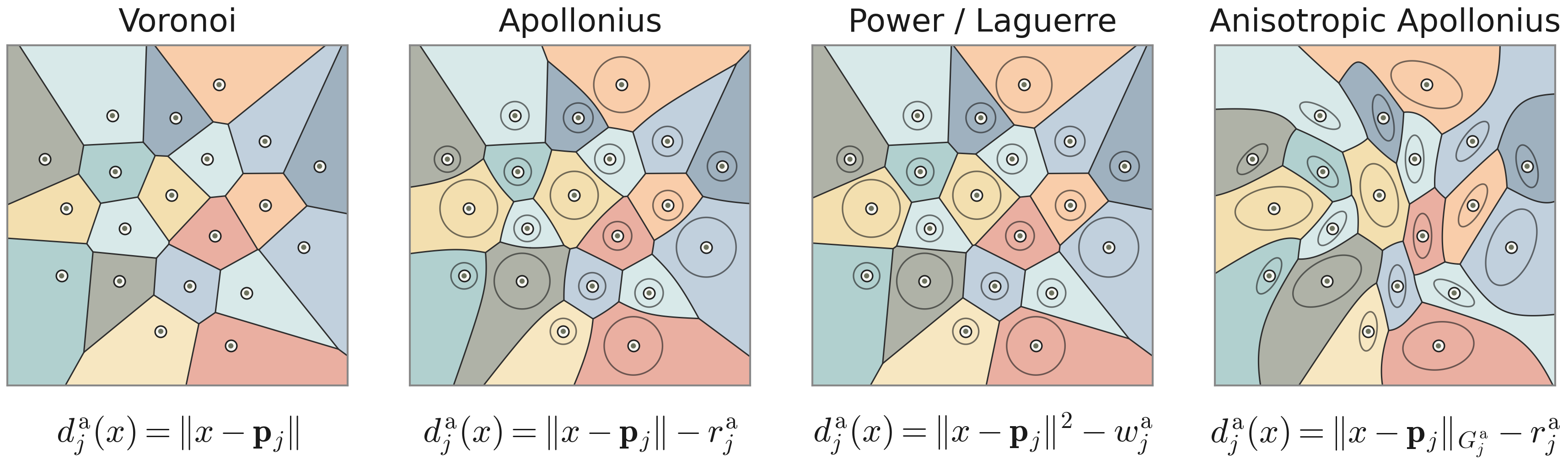
A softmax restricted to the K highest-scoring anisotropic-Apollonius sites at each pixel. Dense sites in a canonical coordinate frame encode local RGB ownership.
One soft anisotropic diagram assigns both appearance and motion: dense sites own the colors, and a coarser set of anchors on the same geometry spans a reduced-order motion basis for each group of pictures.
NeurIPS 2026
1 MIT2 Independent Researcher
Paper Code (coming soon) Models & records (coming soon)
Explicit video primitives decompose a group of pictures (GoP) into local units that can be rendered, inspected, and edited. This is challenging for implicit neural representations, which typically encode a clip holistically in network weights. Existing GoP-based methods model appearance with explicit primitives such as 2D Gaussians, but their motion network consumes appearance budget and obscures which parameters move which region. Our insight is that in a short GoP, nearby primitives often move together, so the rule that decides which primitive owns a pixel can also decide which primitives share a motion, and a small set of shared motions can efficiently encode a GoP’s deformation. We introduce Dynamic Soft Anisotropic Diagrams (DSAD), which apply one soft-distance geometry at two scales: dense sites of a Soft Anisotropic Diagram (SAD), a top-K-masked softmax over anisotropic Apollonius scores, own local colors, and coarser anchors reuse the same geometry to form a partition-of-unity motion basis, which a reduced-order model (ROM) pairs with knot-based temporal coefficients. The ROM uses only 0.24–0.46 of the parameters read by D2GV’s MLP, which frees budget for appearance. On Bunny, UVG, and DAVIS, DSAD has the highest PSNR among compared GoP primitives, though D2GV-AR has higher MS-SSIM on UVG. Against D2GV with its original MLP at 1280×720, at matched training length and decoder-read parameters, DSAD gains a mean +1.92 dB and wins 223 of 302 GoP–budget pairs, leading on every DAVIS scene while D2GV leads on 3 of 7 UVG scenes and 3 of 32 in a wider DAVIS pool; the margin holds at 1080p. DSAD decodes at 706–1,095 FPS from a cold start on one RTX 2080 Ti.
One soft-distance geometry at two scales: for appearance ownership and for motion coordinates.
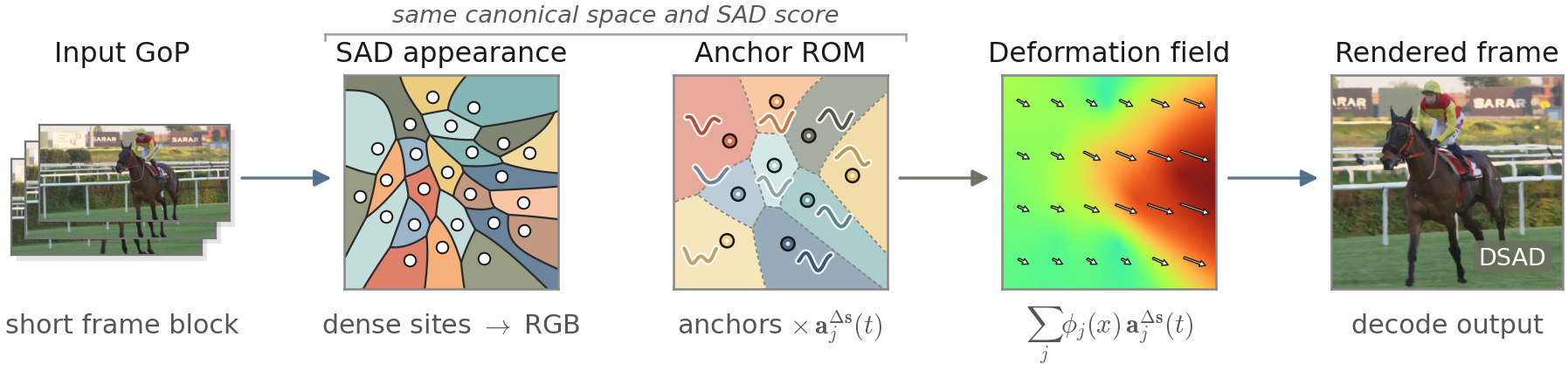
Three layers over a shared soft-distance geometry, fitted to each group of pictures (GoP).
A softmax restricted to the K highest-scoring anisotropic-Apollonius sites at each pixel. Dense sites in a canonical coordinate frame encode local RGB ownership.
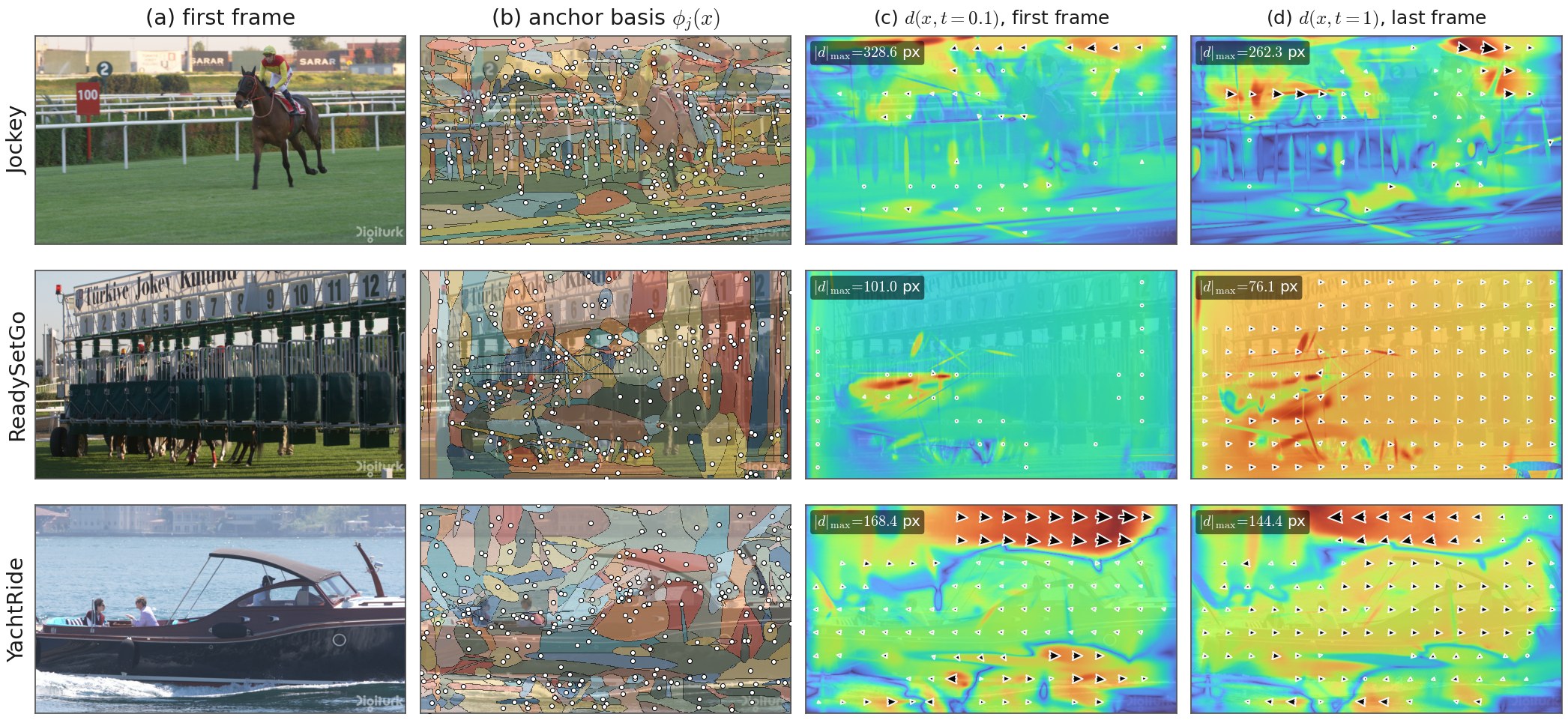
A coarser set of anchors reuses the SAD geometry, so that the anchor weights φj(x) form a partition-of-unity motion basis, without an additional neural module.
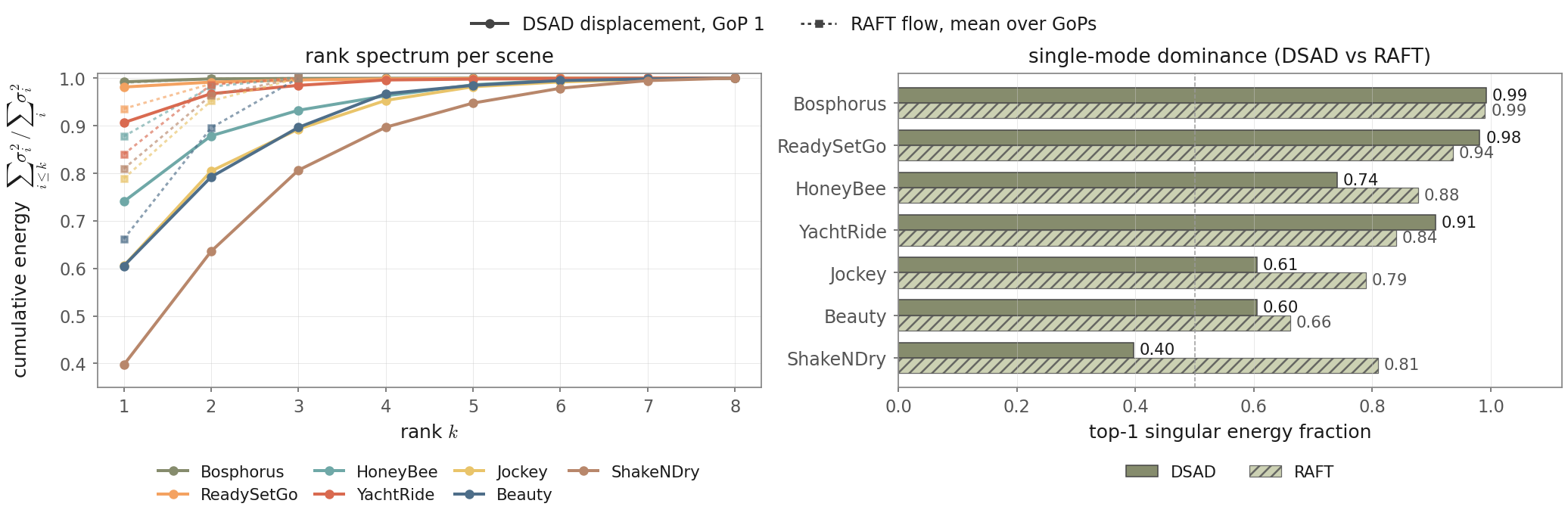
Deformation factorizes into this spatial basis and knot-based temporal coefficients aj(t), one curve per anchor: many sites, few independent motion patterns.
Δ(x, t) = ∑j φj(x) aj(t)applied to each site's canonical position before the tanh that maps it to the image
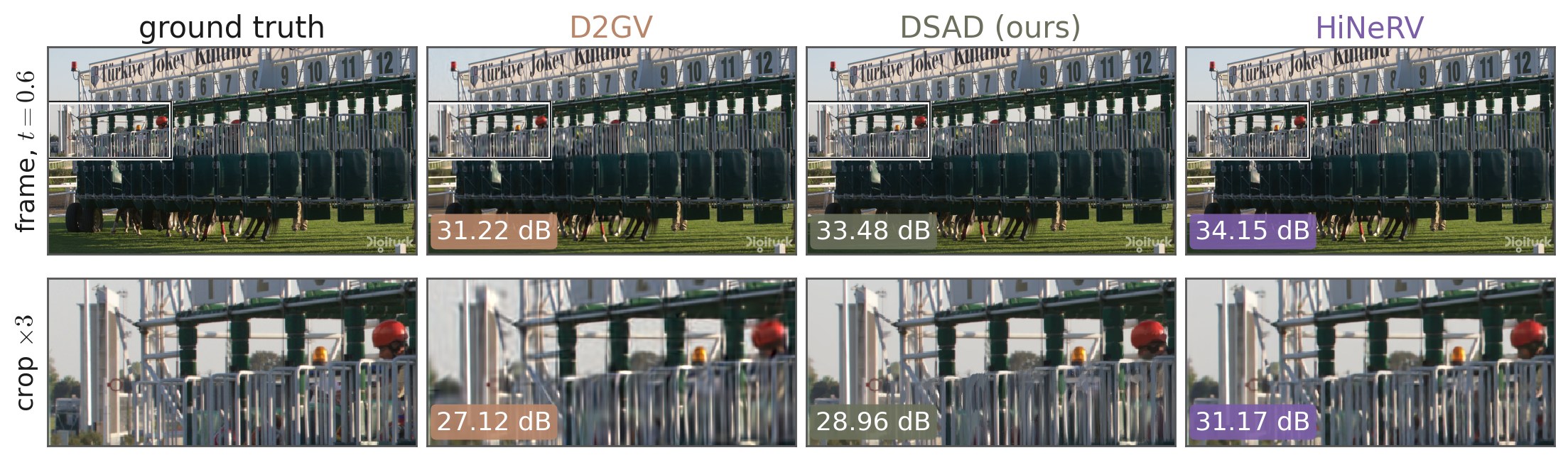
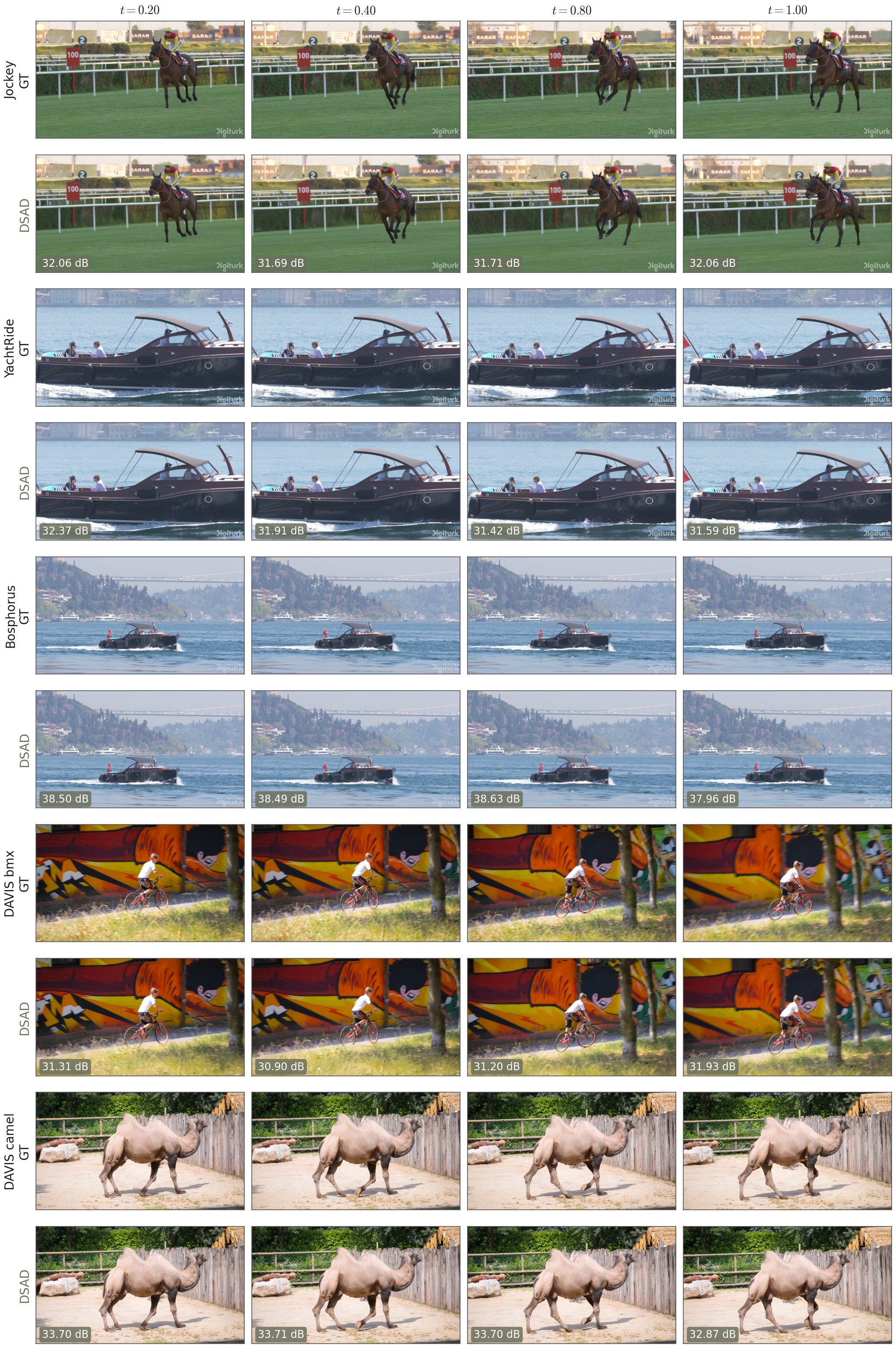
UVG and DAVIS at 1280×720 under D2GV-AR's budgets, against GoP primitive representations.
Main comparison under the D2GV-AR budgets. Per-video PSNR (dB) and MS-SSIM (higher is better). Italics: transcribed from D2GV-AR; upright: our runs (DSAD decoded from its stored parameters). DSAD and the paired D2GV (original MLP) fit identical GoPs with an L2 loss and 120k fine iterations, at budgets matched on the parameters each decoder reads; D2GV-AR’s training loss includes an SSIM term. The unranked second DSAD row uses the ten-scalar-per-site storage count (10% fewer sites). The last row is the per-GoP paired margin of DSAD over the paired D2GV in dB (GoP–budget pairs won). Ranks are shaded among the GoP primitives, ties sharing a rank: 1st, 2nd, 3rd. The paper’s table also lists full-clip implicit representations (INRs), ranked separately.
| Method | Source | UVG-Small | UVG-Large | DAVIS-Small | DAVIS-Large | ||||
|---|---|---|---|---|---|---|---|---|---|
| PSNR ↑ | MS-SSIM ↑ | PSNR ↑ | MS-SSIM ↑ | PSNR ↑ | MS-SSIM ↑ | PSNR ↑ | MS-SSIM ↑ | ||
| GoP primitives: baselines | |||||||||
| D-3DGS | from D2GV-AR | 26.27 | 0.8868 | 28.54 | 0.9124 | 24.54 | 0.8385 | 26.48 | 0.8808 |
| D2GV-AR | from D2GV-AR | 35.03 | 0.9663 | 35.83 | 0.9728 | 29.82 | 0.9457 | 31.87 | 0.9668 |
| D2GV (original MLP, paired) | reproduced | 34.80 | 0.9592 | 35.61 | 0.9636 | 29.82 | 0.9361 | 32.48 | 0.9673 |
| GoP primitives: ours | |||||||||
| DSAD | ours | 35.50 | 0.9635 | 36.43 | 0.9704 | 33.97 | 0.9745 | 35.93 | 0.9826 |
| DSAD (10 numbers per site) | ours | 35.36 | 0.9624 | 36.33 | 0.9698 | 33.63 | 0.9726 | 35.69 | 0.9821 |
| DSAD − D2GV (paired), ΔPSNR | ours | +0.81 (65/98) | +0.97 (55/98) | +4.18 (53/53) | +3.47 (50/53) | ||||
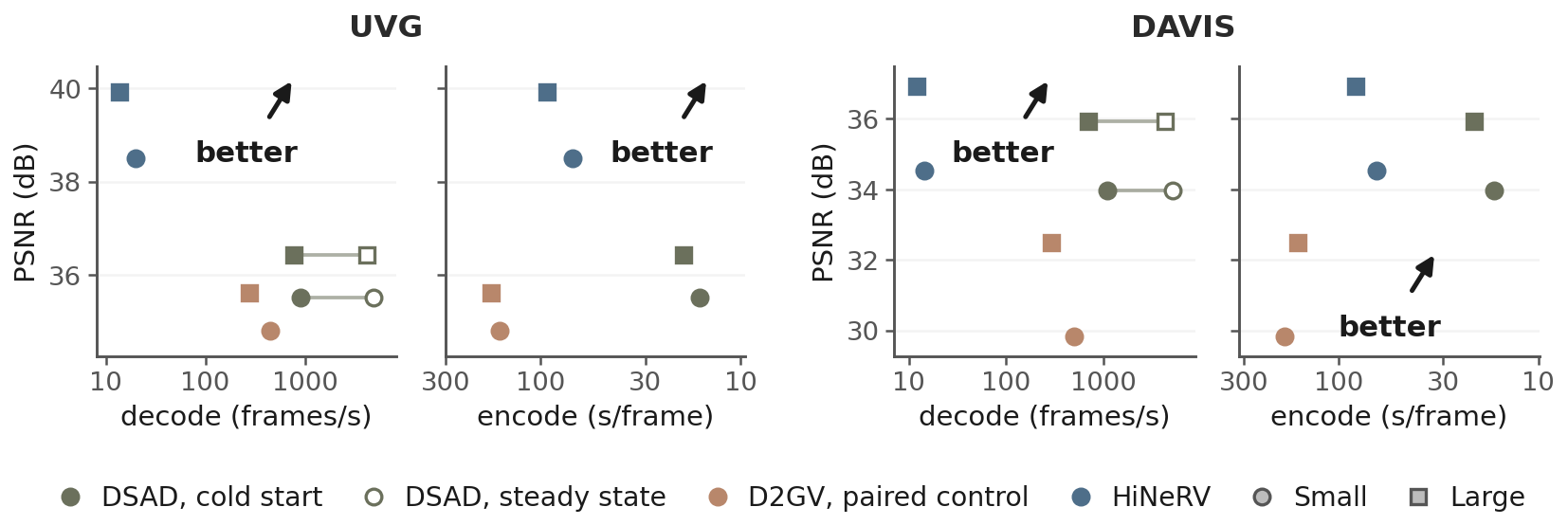
Decode and encode speed at 1280×720 on one idle RTX 2080 Ti.
Decode and encode speed at 1280×720, measured on GoP1 of every scene, as the mean over the scenes of each split. Decoding starts from the stored parameters, one frame at a time, and is timed end to end: the DSAD cold start rebuilds site axes and exact top-8 candidates; the steady state reuses cached candidates. The paired D2GV’s first row omits the opacity branch its renderer never reads and builds its frame times on the GPU once per GoP (the frames bit-identical), the row below is its unmodified original implementation; the lightweight D2GV is timed the same way (unmodified: 365–466 FPS). D2GV’s encode times are estimated from timed windows of its fit (the paper’s Appendix J). Decode FPS: higher is better; encode seconds per frame: lower is better.
| Method | UVG-Small | UVG-Large | DAVIS-Small | DAVIS-Large |
|---|---|---|---|---|
| GoP primitives | ||||
| D2GV, paired control, decode FPS | 444 | 279 | 501 | 294 |
| original implementation, decode FPS | 336 | 224 | 376 | 238 |
| D2GV, lightweight MLP (60k), decode FPS | 587 | 428 | 597 | 452 |
| DSAD, decode FPS, cold start | 909 | 769 | 1,095 | 706 |
| DSAD, decode FPS, steady state | 4,946 | 4,196 | 5,187 | 4,361 |
| D2GV, paired control, encode s/frame (120k) | 161.2 | 177.0 | 187.5 | 161.0 |
| D2GV, lightweight MLP, encode s/frame (60k) | 78.5 | 66.5 | 89.6 | 66.4 |
| DSAD, encode s/frame (120k) | 16.1 | 19.3 | 16.7 | 20.9 |
A short GoP holds many sites but only a few independent motion patterns.
To be updated with the proceedings entry.
@inproceedings{dou2026dsad,
  title     = {{DSAD}: Dynamic Soft Anisotropic Diagrams for Reduced-Order Video Representation},
  author    = {Dou, Zhiyang and Iinbor, Laki and Matusik, Wojciech},
  booktitle = {Advances in Neural Information Processing Systems (NeurIPS)},
  year      = {2026}
}